Southern Rockhopper Penguin kept in captivity in Japan face a major challenge: a low fertilization rate (the percentage of fertilized eggs among those laid), resulting in a significant number of unfertilized eggs and a failure to hatch chicks. Tokyo Sea Life Park is implementing various initiatives to address this issue. This time, we will introduce one of them.
Wild Southern Rockhopper Penguin, both male and female, live in separate ocean areas outside of the breeding season. During the breeding season, the male is the first to come ashore and prepare a nest to welcome the female. A few days later, the female joins him and breeding begins.
However, the aquarium had been keeping males and females together year-round. As a result, during the breeding season, males and females would gather at the same time in the nesting area and form pairs, meaning the males didn't have a period to focus on nest building. Therefore, referencing their natural behavior, we separated the males and females before the breeding season, creating a period for the males to concentrate on nest building.
First, in preparation for egg-laying around April, we moved the birds from the outdoor exhibit to an indoor breeding facility in February. The indoor facility consists of four interconnected rooms, with two rooms allocated to the males and two to the females, separated by doors. This allowed the males to concentrate on nest building, such as securing a location and gathering nesting materials, before forming pairs. We then improved the breeding environment so that the birds would only be introduced to the females once the nest was ready.
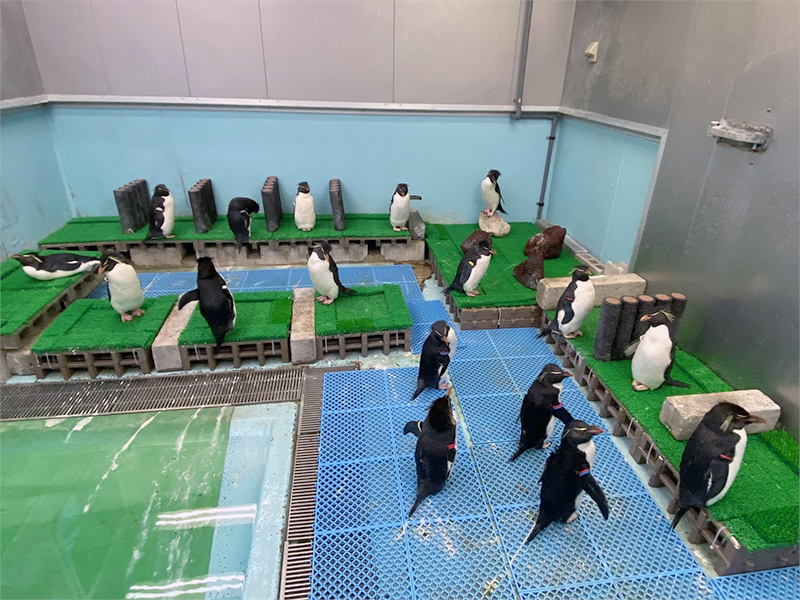
Before cohabitation with the female, the male appears to be securing a place to build a nest.
This is what it looks like when the male has finished preparing the nest and the female has moved in with him.As a result of implementing and continuing various initiatives, including those described above, the average fertilization rate has improved from approximately 40% before the initiatives to approximately 60% afterward. We believe this is likely because changing the rearing location between the breeding and non-breeding seasons allowed the fish to engage in their natural breeding behavior, and they became better able to transition to the breeding season than before the initiatives were implemented.
The improved fertilization rate is a very welcome result! However, now we face a new challenge: improving our chick hatching techniques. We will continue to tackle each challenge one by one and strive to create an even better breeding environment.
You can see what's happening in the indoor breeding facility on a monitor located at the bottom of the stairs in the "Penguin Ecology" area. When you visit the park, be sure to check out the breeding process!
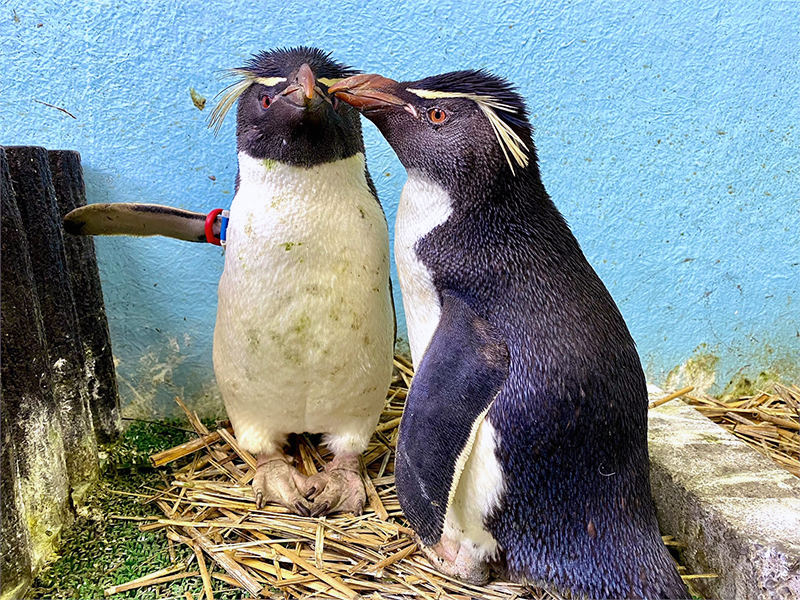
A pair of Southern Rockhopper Penguin have formed. The one on the left is the male, and the one on the right is the female.[Tokyo Sea Life Park]
(April 14, 2023)