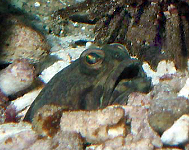
In the "World's Oceans" area, in the "Baja California" tank, bullseye jawfish are incubating their eggs. If you peek in carefully, you can see them peering out from holes dug in the white coral sand with their big eyes.
Jawfish have large, powerful jaws, which are likely useful for digging burrows in the seabed and ambushing and eating small fish and shrimp that pass over their holes. In an aquarium, you can see them busily building burrows by gripping pieces of coral with their mouths.
The large mouth has another important function: the male protects the eggs inside. When it's feeding time, he places the eggs in the burrow and then goes to eat, but as the hatching time approaches, he seems to stop eating. The eggs hatch in about eight days, and the larvae, which are about 4 mm long, swim out of his mouth.
While only a minority of marine fish protect their eggs, other known types include those that brood their eggs in their mouths, those that carry their eggs attached to their bodies, and even those that protect not only their eggs but also their hatched fry.
(For more details, please see
ZooExpress email newsletter No. 33. The photo shows a male peeking out of a burrow [not carrying eggs].)