2024 is the Year of the Dragon. The animal associated with the Year of the Dragon is the "dragon" (tatsu, ryū). Although the dragon is a mythical creature, the aquarium exhibits animals related to the dragon. The aquarium will be open from January 2nd (Tuesday) for the New Year's holiday in 2024. Please come and visit the aquarium to meet the "dragons"!
A type of seahorse: the "Big Belly Seahorse"
This seahorse species inhabits the seas from southern Australia to New Zealand. While it is usually displayed in the "Western Australia" tank at the aquarium, captive-bred individuals are on display in the "Topic Exhibition" tank in front of the information counter on the second floor of the main building until January 9th, 2024 (Tuesday).
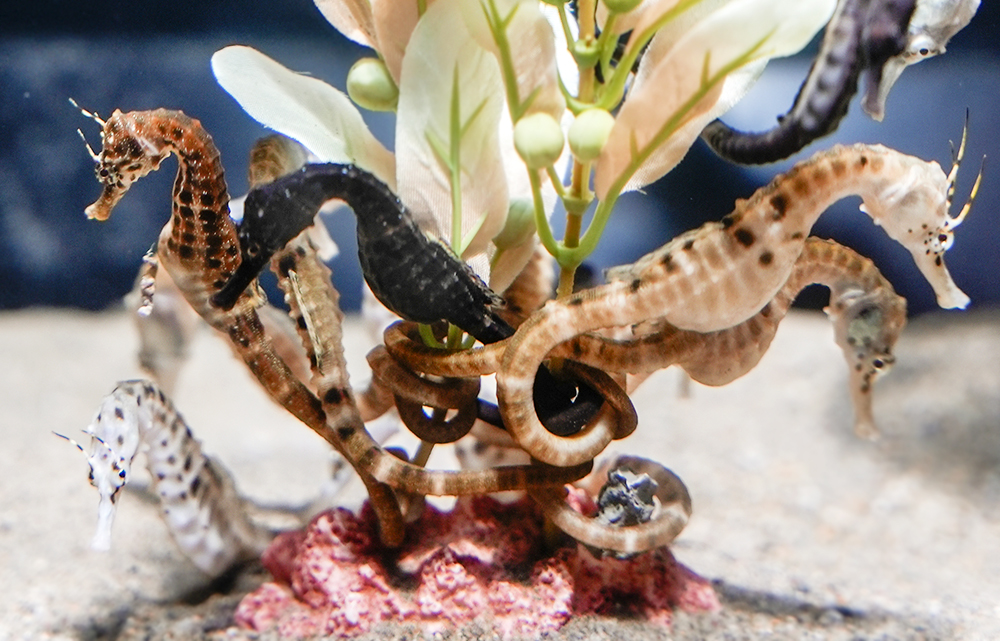
"Topic Exhibit" Aquarium: Big Bellyed SeahorseThe Japanese name for seahorse, "tatsunootoshigo," derives from its unique body shape. With its hard bony plates, slender mouth, and curved body, it is quite different from the typical image of a fish. This is likely how it came to be called "dragon's offspring."
Some species of seahorses, including the big-bellyed seahorse, are known to have a pouch on the male's belly for raising offspring. The female lays her eggs in this pouch, and the male releases sperm to fertilize them. The hatched offspring grow inside the pouch and emerge from it looking like adult seahorses. The name "big belly" refers to the large belly, and it can be said that the male, raising its young, takes on a form befitting its name.
Weedy Seadragon whose name includes the word "dragon"
Weedy Seadragon, despite its name, is a close relative of the seahorse. While Eastern and Western dragons are said to have different origins and appearances, the terms have been used interchangeably in translation. At the aquarium, it is exhibited in the "Western Australia" tank, along with the Big Belly Seahorse.
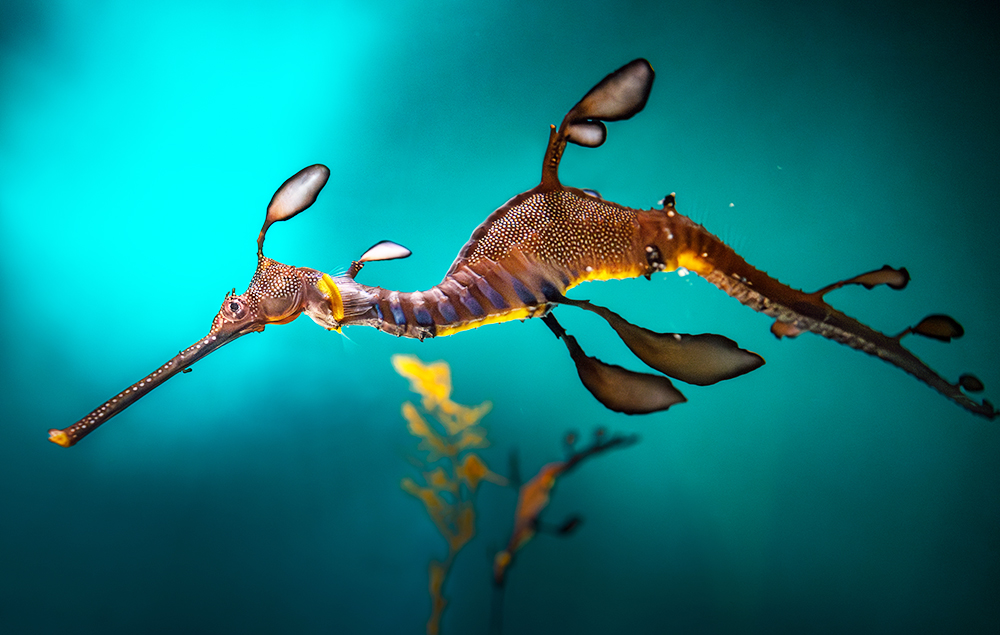
Weedy Seadragon swimming in the aquariumAs you can see in the photo, the seahorse has parts called "dermal flaps" on its body, giving it the appearance of floating seaweed. While many seahorses cling to seaweed with the tip of their tails, Weedy Seadragon always swims slowly, and combined with its large body, it presents a majestic, dragon-like presence.
Watch the video on Tokyo Zoo Net BB.
The individuals on display were bred at the zoo in 2019. We also received certification from Japanese Association of Zoos and Aquariums for our first successful breeding (
see announcement). Currently, the largest individuals are about 30cm in length, but they can grow up to over 40cm.
Stuffed animal of the Year of the Dragon
Tokyo Zoological Park Society, produces and sells original plush toys each year based on the animals of the Chinese zodiac. The model for 2024, the Year of the Dragon, is a Big Bellyed Seahorse. The design was carefully crafted and completed after supervision from animal keeper. This plush toy is filled with the unique attention to detail that only Tokyo Sea Life Park. It is available for purchase at the aquarium and on the online store "Tokyo Zoo Shop" (
product information page). 1,980 yen (tax included).
For more behind-the-scenes stories about the plush toys' creation,
please see the latest issue of the aquarium's information magazine, "SEA LIFE NEWS" (2023 Vol. 21 No. 6) (also available online).
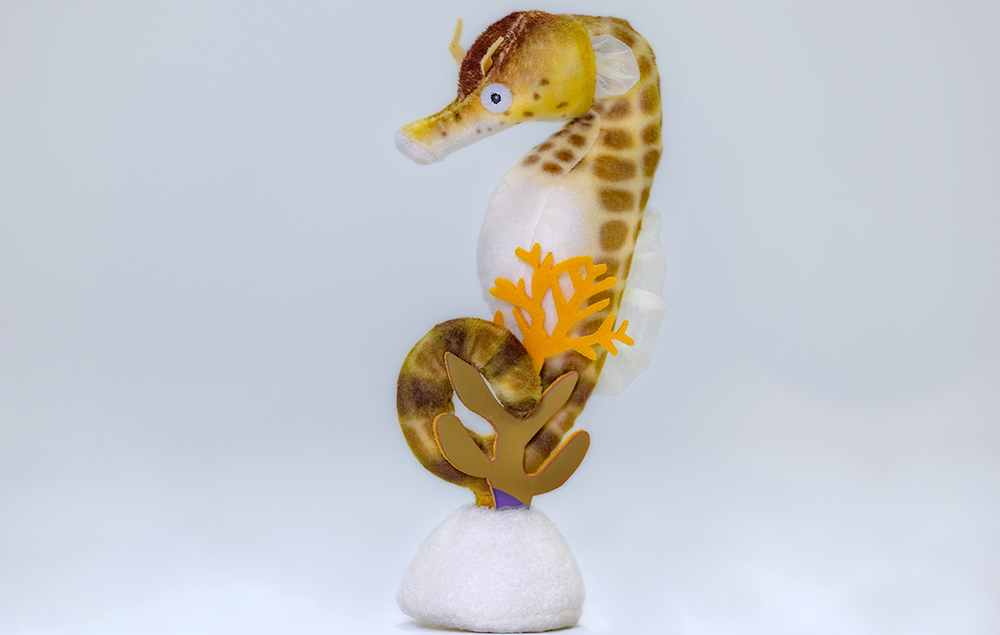
A stuffed animal representing the Chinese zodiac. The model is a Big Bellyed Seahorse.Tokyo Sea Life Park will be open until December 28th (Thursday) this year (2023), and from January 2nd (Tuesday) in the new year (2024) until January 9th (Tuesday), including January 3rd (Wednesday). Opening hours are from 9:30 to 17:00, with last entry at 16:00. Admission fees are 700 yen for adults, 350 yen for those 65 and over, and 250 yen for junior high school students (elementary school students are free. Junior high school students residing in Tokyo or attending junior high school in Tokyo are also free).
(December 26, 2023)