At Tokyo Sea Life Park 's exhibit tank "Voyagers of the Sea: Tuna," a series of deaths among the exhibited Pacific Bluefin Tuna, Kawakawa, Striped Bonito occurred between December 2014 and January 2015, resulting in only two Pacific Bluefin Tuna tuna remaining on display (as of March 3, 2015).
-
News: "Regarding the decrease in the number of exhibited Pacific Bluefin Tuna and other fish (Follow-up report)"
We have requested pathological examinations from three external research institutions and are continuing our investigation into the cause of death. While we have not yet determined the cause, we would like to inform you of the results of the examinations conducted by these external institutions to date.
Status of pathology testing at external research institutions
Twenty-eight specimens (16 Pacific Bluefin Tuna tuna, 6 Kawakawa Striped Bonito, and 6 bonito) were selected from the dead fish suspected of having diseases or other conditions, and pathological examinations were requested from external research institutions (Nihon University, Fisheries Research Agency, and Tokyo University of Marine Science and Technology). The following conditions have been confirmed through these examinations. Pathological examinations and analyses will continue at the external research institutions.
○Nihon University3 samples (Pacific Bluefin Tuna: 2 samples, Kawakawa: 1 sample)
| virus | As we previously reported in this news article, the virus was detected in all three spleen samples.
Subsequent testing revealed that the virus was neither red iridovirus nor a virus that causes viral neuronecrosis. Further testing is ongoing to identify the specific virus. |
| Bacteria | Not detected. |
| parasite | No parasites that cause fatal symptoms were detected. |
○ Fisheries Research Agency (an independent administrative agency)18 samples (Pacific Bluefin Tuna: 11 samples, Kawakawa: 2 samples, Striped Bonito: 5 samples)
| virus | Red sea bream iridovirus was not detected. Testing for other viruses is currently ongoing. |
| Bacteria | Not detected. |
| parasite | Not detected. |
| others | Lesions were observed in the liver and other tissues of all three species: Pacific Bluefin Tuna, Kawakawa, Striped Bonito. |
*We have requested an examination of Pacific Bluefin Tuna that died on February 25th.
○Tokyo University of Marine Science and Technology7 samples (Pacific Bluefin Tuna: 3 samples, Kawakawa: 3 samples, Striped Bonito: 1 sample)
| virus | No red sea bream iridovirus or viruses that cause viral neuronecrosis were detected. Testing for other viruses is currently ongoing. |
| Bacteria | Not detected. |
| parasite | Not detected. |
*Red sea bream iridovirus
This disease is damaging not only red sea bream but also many other marine farmed fish in aquaculture farms. Infected fish become lethargic, exhibit symptoms of severe anemia, petechial hemorrhages in the gills, and spleen enlargement. It belongs to the Iridoviridae family and is named red sea bream iridovirus (RSIV).
*Viral neuronecrosis
This is currently one of the most feared viral diseases in the production of marine fish fry. Infected fish exhibit abnormal swimming behavior, swimming in circles, and in most cases, they die. The cause is a virus classified in the genus Beta-Nodavirus of the family Nodaviridae.
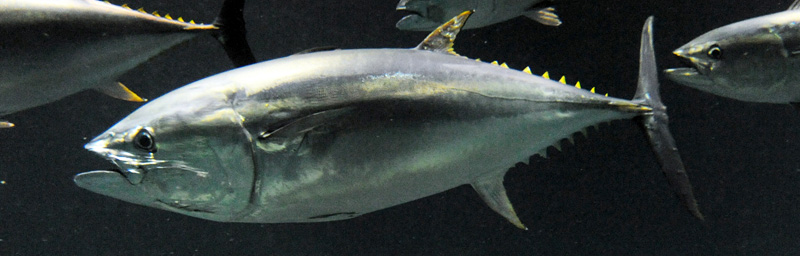
Pacific Bluefin Tuna (photographed on December 1, 2014)(March 3, 2015)