Let me introduce you to the wrasse found in the "Great Barrier Reef" tank in the "World's Oceans" area of Tokyo Sea Life Park.
The pygmy wrasse is distributed in the central to western Pacific Ocean, the Indian Ocean, and in Japan south of Suruga Bay, and can be found in shallow coral reefs and rocky areas. Its most distinctive feature is its pointed mouth, which resembles a bird's beak. It uses this mouth to eat crustaceans and other creatures that hide among corals. It is a fish that has been remarkably adapted to living in coral reef areas.
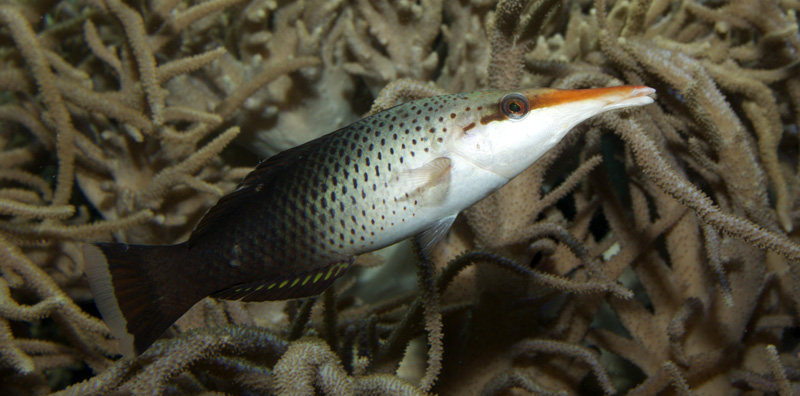
Nail spatula (Initial Phase)The wrasse currently in the tank is in what's called the "initial phase" stage, with a white body that turns black towards the rear and a bright orange color on the upper part of its snout. (The term "initial phase" means "early stage.") This is a bit complicated, but let me tell you about the interesting physical changes that occur in wrasses.
It was once believed that wrasses were fish that could change sex from female to male. It was thought that when they changed sex, their body color and patterns would change, making it possible to distinguish between males and females. However, recent research has shown that some individuals are born male, so it's not that simple.
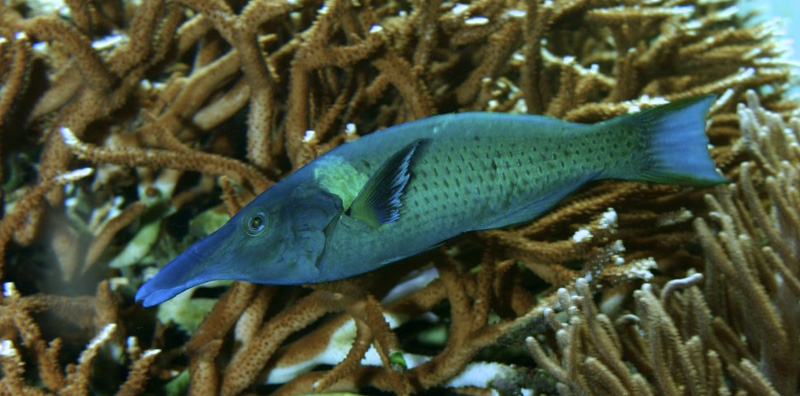
Nail wrench (terminal phase)Therefore, depending on the changes in body color and pattern that accompany growth and sex change, individuals in the initial stage are called the initial phase, and individuals in the final stage of change are called the terminal phase. In aquariums, this terminology is used for fish of the wrasse and parrotfish families, which were thought to change in body color and pattern when they undergo sex change.
Is the wrasse in the tank a female? Or is it a male whose body color hasn't changed yet? Even we, animal keeper, don't know. We plan to add more individuals in the initial phase to the tank. Perhaps we'll be able to observe one of them transform into a vibrant green terminal phase.
[Tokyo Sea Life Park]
(April 3, 2015)