Currently, at Tokyo Sea Life Park 's "Tokyo Sea" area, in the "Shore Creatures" tank, you can see cardinalfish protecting their eggs.
The cardinalfish (Epinephelus fuscoguttatus) is a fish about 12 centimeters long that inhabits rocky coastlines south of central Honshu. It lives in large schools of several thousand to tens of thousands of individuals in very shallow waters, up to about 100 meters deep near the seabed. It can be seen around breakwaters and rocky shores, so it may be a familiar fish to anglers.
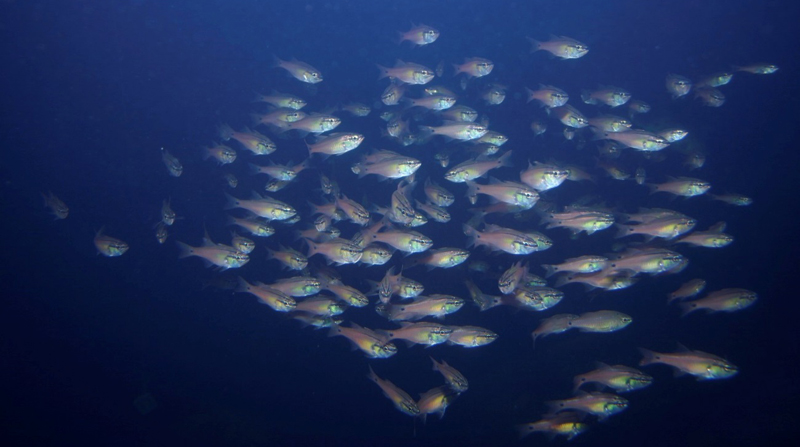
School of cardinalfishIf you observe the cardinalfish in the aquarium closely, you can see individuals with a slightly swollen lower jaw and a large, enlarged mouth. These are males that are holding a mass of eggs in their mouths to protect them from predators. Cardinalfish have a habit of males protecting the egg mass laid by the females in their mouths for about a week until it hatches (mouthbrooding). Females that are close to spawning will lure males out of the group and lay their eggs outside the group. It is said that males sometimes practice opening their mouths to hold the eggs.
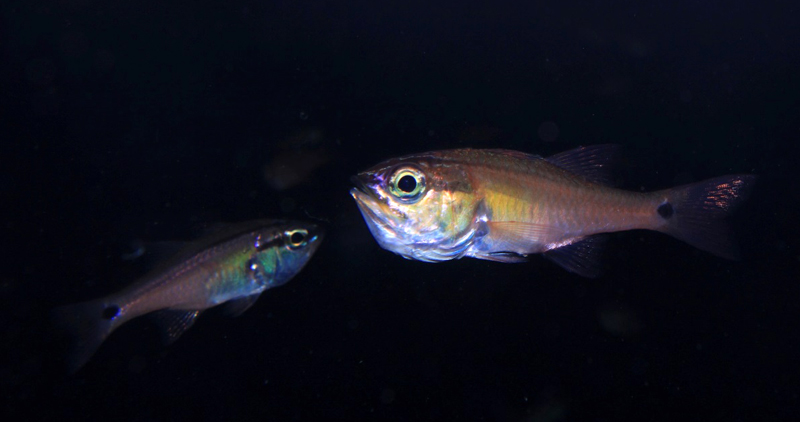
The male with a swollen mouth (right)The male, holding the egg mass in its mouth, opens its mouth wide and spits out and puts back some of the eggs to send fresh seawater into the eggs. The male protects the eggs without eating until they hatch.
Incidentally, the female apparently eats a lot of food right away in preparation for the next spawning. The eggs are orange when they are first laid, but they gradually turn black as development progresses.
The best time to observe the marine life in the beach aquarium is in the afternoon. Cardinalfish often gather in schools at the back of the tank in the morning, but as the afternoon and evening progress, they move closer to the glass, making them easier to observe. Also, males that are mouthbrooding may separate from their group and swim together in groups of other males who are also mouthbrooding.
Be sure to look for cardinalfish with large, bulging mouths. If you're lucky, you might even be able to observe the eggs inside their mouths.
[Tokyo Sea Life Park]
(July 24, 2015)