Tokyo Sea Life Park features a fish called the roi des rougets in its "Mediterranean Coast" tank. This fish inhabits rocky reefs from the Mediterranean Sea to the western Atlantic Ocean. It is said to be a nocturnal fish, hiding in overhanging rock crevices and caves during the day and coming out at night.
Roa del je means "king of red fish," and as the name suggests, it has a beautiful, bright red body like a ruby. In fact, the Roa del je is a fish of the same family as the cardinalfish that I introduced last month.
・
"Inside the mouth of the cardinalfish..." (July 24, 2015)
Roa del je also engages in "mouthbrooding," where they protect their eggs by holding them in their mouths, and this behavior can now be frequently observed in the exhibit tanks. Male Roa del je take the egg mass laid by the female into their mouths and protect it there until it hatches.
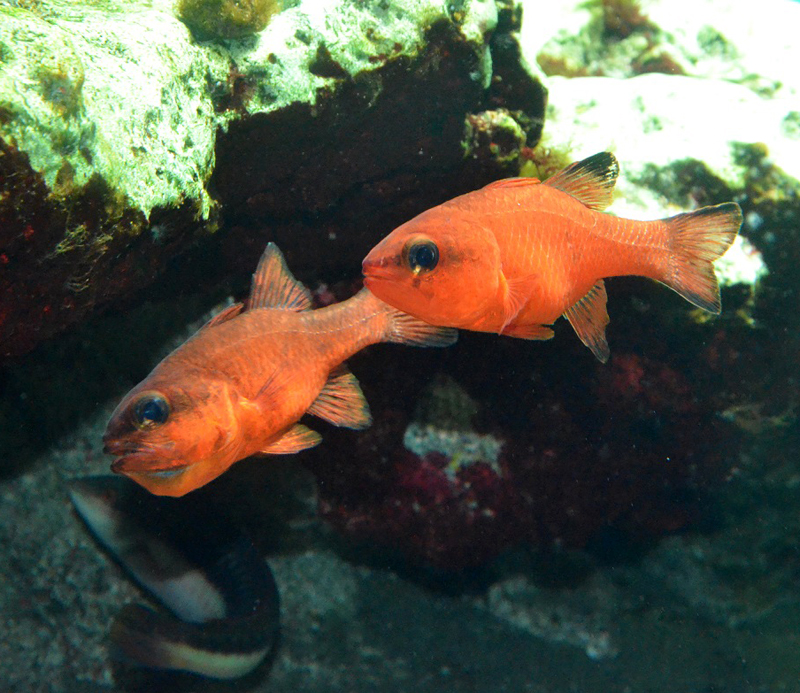
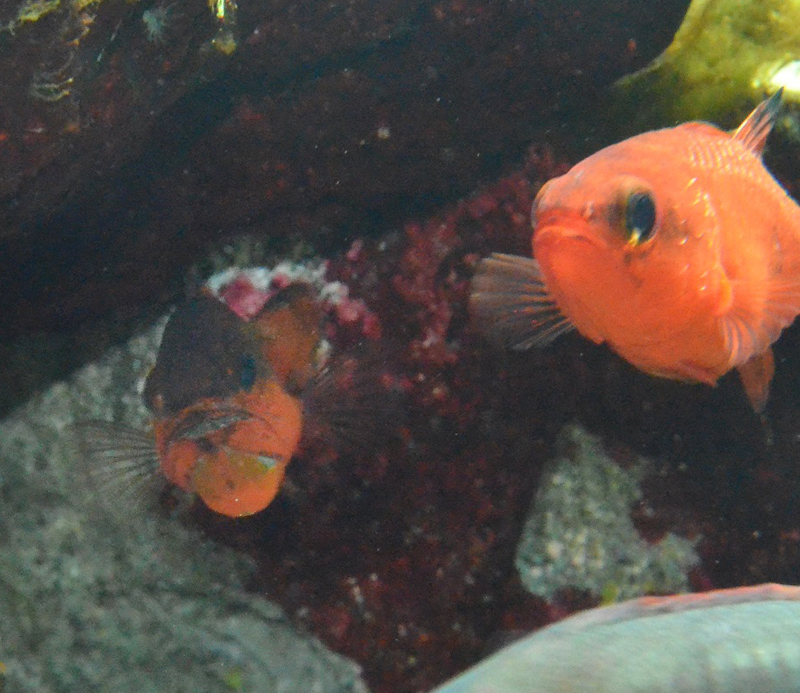
Left: A male brooding eggs in its mouth, and a large-bellied individual believed to be a female. Right: Eggs are faintly visible inside the mouth.
However, fish in the Apogonidae family, to which the Roa del Ge belongs, are known to exhibit a behavior called "filial cannibalism," in which the male occasionally eats the eggs that the female is protecting in her mouth. Male Apogonidae fast while mouthbrooding, but the breeding season is long, and the cycle of "spawning → mouthbrooding → hatching" occurs multiple times during a single season. Therefore, it is thought that the male occasionally eats the eggs to replenish its nutrients in preparation for the next mouthbrooding cycle.
Currently, there are five Roa del Ge fish in the tank, excluding the newly hatched fry. Two of them appear to be females, as they have large bellies. Of the three non-female fish, one is still small, and its sex is not yet known. One of the two males seems to be frequently mouthbrooding. The other male, who doesn't mouthbrood as much, seems to be ignored by the females, perhaps because of his small size.
The breeding season for wild Roa del Ge is said to be from June to September. In aquariums, they often hide in the shade of rocks during the day, but they occasionally come out. If you're lucky, you might see them protecting their eggs with their mouths full, or even see the eggs inside their mouths.
[Tokyo Sea Life Park]
(August 29, 2015)