Tokyo Sea Life Park has various departments, including animal care and exhibition staff, and education and outreach staff.
As part of
the commemorative projects for our 35th anniversary this year, we will be publishing a series of articles titled "The Dreams of Aquarium Leaders," in which leaders from each department will discuss themes such as "the ideal exhibit/aquarium" and "what they want to do and their dreams for their future work."
The 6th "Aqua Positive"
"What can an aquarium do in the face of starving children?"
Huh? Even if you say that... I can't do anything? I haven't been able to do anything?
And here's another one: "Aquariums are lying. What kind of lies are they telling?"
Are you surprised, or are you thinking, "Of course"?
Some people might be surprised to hear that aquariums lie. Let me give you a few examples. For instance, mimicry. Weedy Seadragon mimics seaweed. The stonefish mimics rocky reefs. Aquariums might also be mimicking something. You might go in expecting to just casually kill some time, but you might find that they are actually quite deep and conducting academic research. They may not look like it, and nature lies too. Aquariums sometimes use mimicry.
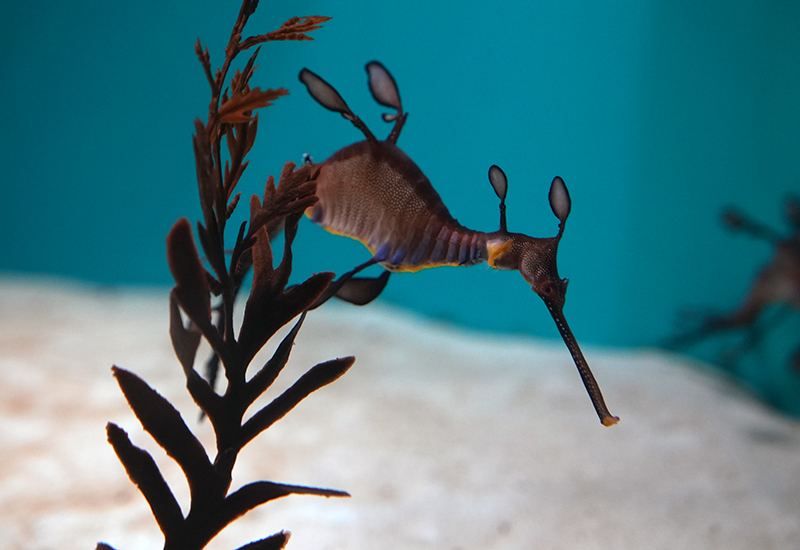
Weedy Seadragon that mimic seaweedAnother example of a lie is conservation. It may seem like we are making a considerable contribution to the conservation of organisms both within and outside their habitats, but quantitatively speaking, that's not really the case. No, we are trying our best. But if we look at it objectively, what is the quantitative impact? Yet, we may be telling lies today, hoping with all our might that this lie will become the truth, aiming, for example, for rare species to become common species.
Is the dream real? Right now it's real, but it's a dream because it's not reality. If that's the case, then is the dream a lie? Yes, in the sense that it's not real at this moment. Wishing while almost giving up, almost giving up but still wishing, continuing to wish and continuing to strive. That's one of the lies at the aquarium.
Modern aquariums are said to have several roles and missions. Among them, wildlife conservation, environmental education, and research are particularly important today. However, simply being enthusiastic about such activities will not be enough going forward. Aquariums themselves will be questioned about their own role in discussing biodiversity conservation and the global environment. The question is whether they are qualified to speak about these issues. It may not be something that is often considered, but aquariums are also facilities that consume a considerable amount of energy and materials. Aquariums are contributing to the environment simply by operating. In the future, it will probably become a prerequisite for aquariums to operate that the aquarium facilities themselves possess high environmental performance. Otherwise, their various activities will lose credibility.
No matter how magnificent the aquarium becomes, even if it creates a magnificent tank that perfectly replicates the ocean, even if it successfully breeds rare species within the aquarium for wildlife conservation, and even if it conducts outstanding exhibits and educational activities that earn it awards from the Ministry of Education, Culture, Sports, Science and Technology and boards of education, if it consumes enormous amounts of electricity generated from non-renewable energy sources (such as coal-fired power plants), continuously discharges polluted water after using large quantities of seawater and freshwater, and while animal welfare barely meets legal standards, the working conditions are far from ideal, even if not illegal, leaving staff exhausted... then it's simply not convincing.
First, I want to do as much as I can with what I can do now. Eliminating single-use plastics, introducing sustainable food, replacing equipment with energy-saving models, utilizing discarded fishing nets, developing technologies to reduce seawater usage, and transitioning to renewable energy... These are some of the things Tokyo Sea Life Park has been working on over the past decade or so. On top of that, what we want to achieve even more will be passed on to the new aquarium in 2028, which will involve a complete renovation of the facility itself.
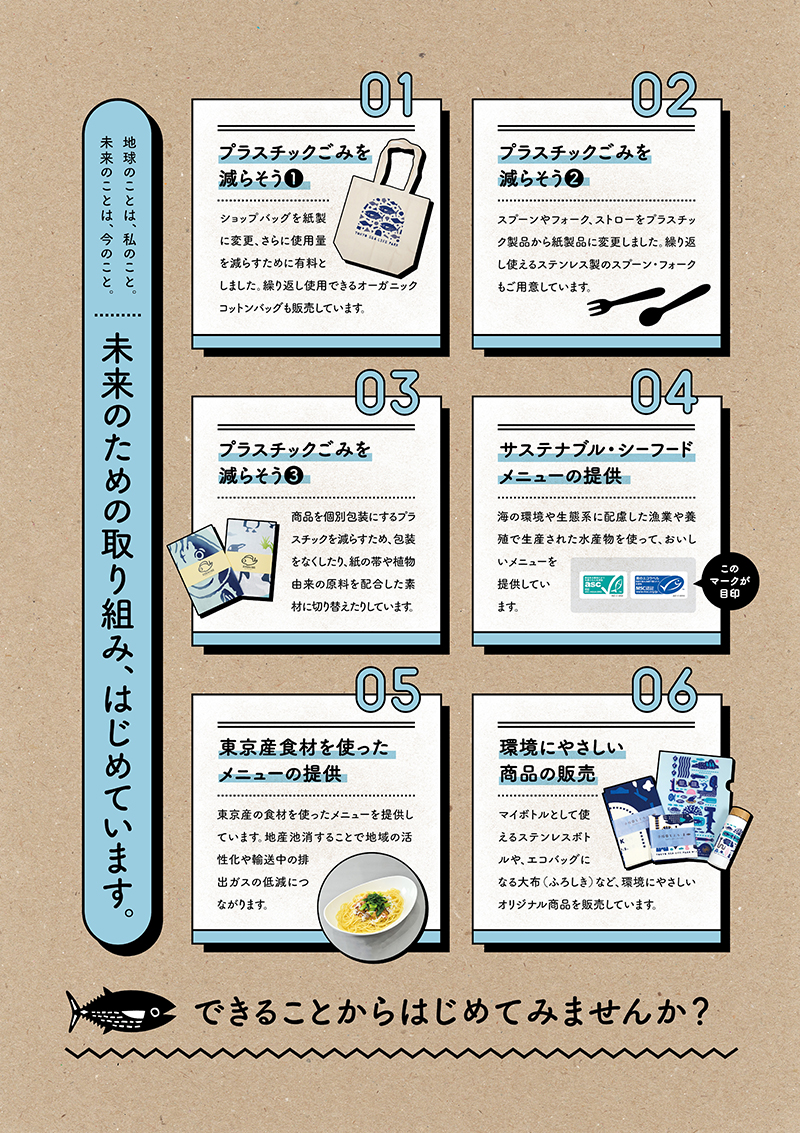
Aquarium's "Initiatives for the Future"Imagine this: Water drawn from Tokyo Bay is filtered thoroughly, its salinity and other properties are adjusted, and it is carefully recycled and used as aquarium water, returning cleaner water than when it was drawn after use. When collecting wild animals from nature, efforts are made to collect them in a way that does not negatively impact the maintenance and reproduction of endemic populations, and an equal or greater amount is returned to nature, or activities are carried out to contribute to conservation. Animals being kept are not only kept physically healthy, but are also allowed to express their natural behaviors and, if possible, are cared for in a way that allows them to feel happiness. Trees are planted on the grounds to cultivate a forest. Zero emissions are achieved throughout the entire facility. For someone who loves aquatic life and has always dreamed of working in an aquarium, and who took a job at Tokyo Sea Life Park this is not a false hope that they know will never come true, nor an instant, catchy phrase of a dream created out of a sense of duty to talk about a dream, but something they can proudly tell children and future generations about. The direction we are aiming for is not just to protect nature, but to regenerate and revitalize it. Instead of aiming to minimize environmental impact, the idea is that the environment improves slightly simply because the aquarium is there and operating. Is that impossible? To make the impossible possible, we must remove preconceived notions and self-imposed limitations. Conversely, preconceptions turn the possible into the impossible.
I believe it's important for aquariums to contribute to reconnecting people, living creatures, and water. I want aquariums to be an indispensable presence, something that makes the world and the planet a little bit better. Tokyo Sea Life Park also hopes to make a small contribution to this.
Now, there isn't yet a word that succinctly describes the aquarium's activities that I've just described. What should we call them? Following the example of nature positivity, which aims to increase the richness of biodiversity as well as conserve rare species, I think we'll tentatively call them "aqua positive."
By the way, from the perspective of social education, aquariums are a type of museum. Museology is the academic discipline that scientifically pursues museums. Soichiro Tsuruta, who is said to have drafted the original Museum Law and has many research achievements on museums, defines museology as "an applied science that studies the purpose of museums and the methods for achieving them, and whose results contribute to the proper development of museums, as well as to the happiness of humankind and world peace." ICOM (International Council of Museums) has included in its new definition of museums that "museums are open to the public, accessible to everyone, inclusive, and foster diversity and sustainability." If we replace museums with aquariums, and humankind with people and living things, this definition can also be applied to aquariums. Rather than aquariums being entities that convey the importance of biodiversity and peace, I believe that aquariums themselves are entities that rely on biodiversity, and are, so to speak, a gift of peace.
For humans and wildlife to live in harmony and for nature to be restored, a transformation of our current society will be necessary. The climate crisis we face is not just an indication, but a clear manifestation of this. The photograph of a "sea tank with no coral reefs" may represent the future of coral reefs. Aquariums should consider taking on the role of leading the way in social change and acting as change-makers.
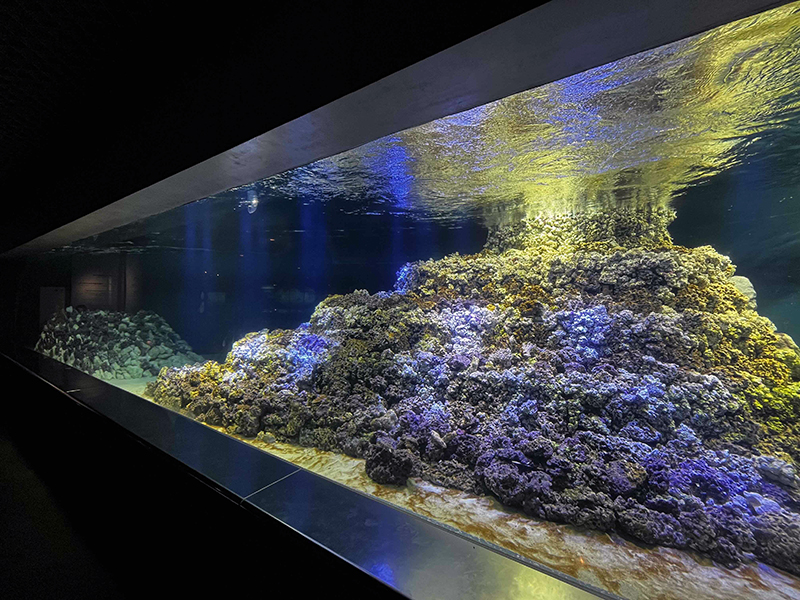
A coral reef tank without coral.Currently, well-being (a good state of being for individuals and society) is attracting attention in various fields. If we are to discuss well-being as something that Japanese zoos and aquariums should aim for, we must consider who their activities have reached and who they have not. This is precisely when dialogue becomes necessary. Not small talk or debate, but dialogue. How much dialogue have we been able to have where we all think together about the happiness of people and living things, peace, and what kind of world we want, what kind of planet we want? Whose property were aquariums not? Were their educational outreach activities merely like trying to get a full child to eat one more bite? If we continue thinking along this line, we may realize that hungry children and aquariums are not entirely unrelated.
In this era, even our understanding of what it means to be a living creature is shaped through social media. This kind of culture, which never existed before, is beginning to encroach upon the real world. In this context, aquariums, which are a kind of medium themselves, are also places where people can encounter not only emotions and insights through their raw physical senses, but also "weakness" and "darkness." By recreating a small marine environment in the aquarium, we hope that children who visit the aquarium will become interested in the sea and living creatures and open up picture books when they get home. We also hope that a few people will realize that aquariums are made up of people with various skills and abilities, not just animal keeper, and that they will think, "I'd like to work here too." With these humble hopes, we hope to increase the number of people who can contribute to reconnecting people, living creatures, and water, and to connect this planet teeming with life to the future. We lower the barrier to entry for aquariums with lies, and we believe that these lies, imbued with hope, will become the truth. Aqua Positive, we are working to preserve this planet.
[Kazuomi Nishikiori, director Tokyo Sea Life Park]
• Serialized article: 35th Anniversary Project "The Dreams of Aquarium Leaders"
[1] Thoughts on the exhibits at the aquarium
[2] The path that aquariums aim for - We want them to always be close to you
[3] Would you like to get involved in the maintenance and management of the facilities that support the aquarium from behind the scenes?
[4] Aquariums where you can learn while having fun
[5] I want to create the ocean
[6] Aqua Positive
[7] Aiming for an inclusive aquarium
[8] The Dreaming Old Man
[9] The job of a "boatman" at an aquarium - Let's continue the dream together!
[10] Value hospitality
[11] What we want to convey from shops and restaurants!! The charm and importance of living things
[12 (Final Episode)] Thoughts and daily life of the Business Division staff
(October 26, 2024)