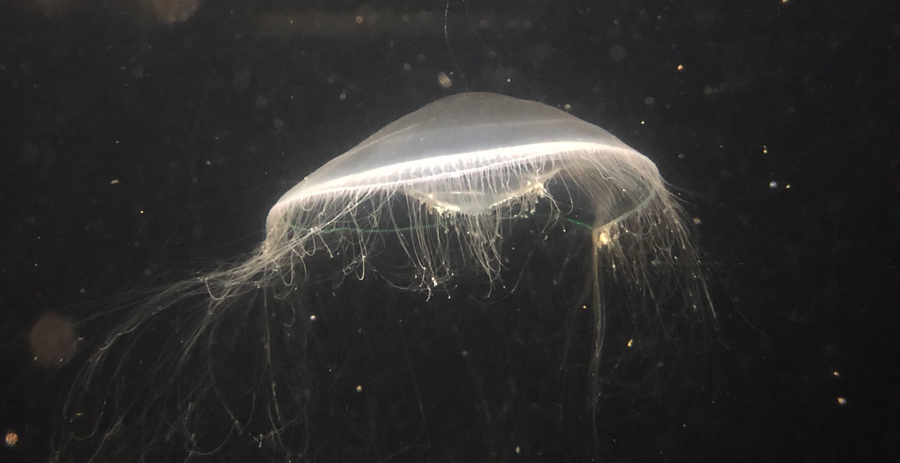
Tokyo Sea Life Park 's "Tokyo Sea" area's "Plankton" section is exhibiting the Aequorea victoria jellyfish for the first time in 10 years. Aequorea victoria jellyfish are widely distributed from India to the Pacific and Atlantic Oceans, and can be seen along the Japanese coast from spring to summer. Their name comes from the fact that the shape and size of their bell resembles a bowl. The bell has many radial canals for transporting nutrients, and they have more than 100 tentacles.
Some of you may remember the glowing jellyfish that became a topic of conversation when Dr. Osamu Shimomura received the Nobel Prize in 2008. This time, we'll introduce the characteristics of the crystal jellyfish, Aequorea victoria, which are more than just its ability to glow.
First, please watch the video. Can you see how the tuft-like part in the center of the bell opens and closes? That's its mouth. The mouth of the Aequorea victoria opens wider than that of other jellyfish, allowing it to swallow other jellyfish of the same species whole or eat small fish.
[Video] Feeding behavior of the jellyfish Aequorea victoria
One day, I noticed that the mouth, which is usually in the center of the umbrella, was positioned towards the edge. So, after feeding it, I observed it for a while and discovered that sometimes it closed its mouth neatly towards the center, and other times it closed with its mouth shifted to the edge.
I don't know why they move this way, but it seems that if the distance from where they catch the food to where they bring it to their mouths is long, they tend to lean towards the edge. Observing where their mouths are located has become a secret pleasure of mine.
Please take your time to observe the jellyfish's mouth closely.