*The exhibition will reopen on Sunday, October 18, 2020.
To prevent the spread of COVID-19, Tokyo Sea Life Park remained temporarily closed from February 29 to June 22, 2020. To prevent the spread of infection among staff, they operated in two teams, ensuring that the teams did not come into contact with each other. This was an unprecedented situation, and there was some confusion in an environment where direct communication among staff members was not possible, but the animals we were caring for wouldn't wait. This was also true for me, who had only recently transferred to the aquarium in April of this year (2020) to be in charge of caring for birds such as penguins and seabirds.
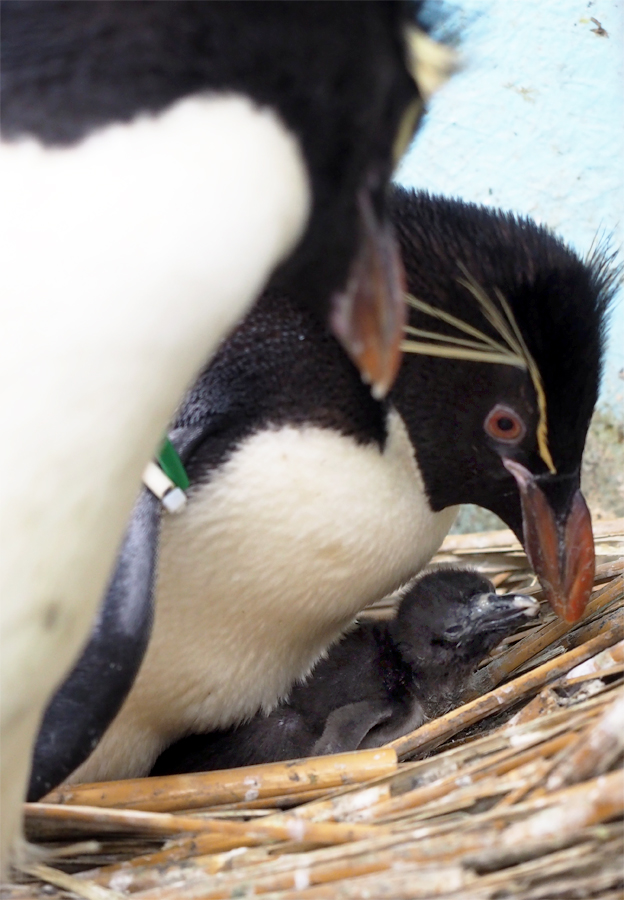
Even amidst the unusual circumstances for humans, Southern Rockhopper Penguin entered their breeding season as usual in March. After nest building, pairing, and egg-laying, two chicks successfully hatched in late May. While the parents are in charge of raising their young, animal keeper need to weigh the chicks daily to check their health.
However, since I had no experience raising penguins, taking the chicks away from their parents was not easy. During the breeding season, the parents are very aggressive and will get angry and bite if you even get close. If you try to reach out forcefully, there is a risk that the parents will accidentally injure the chicks, so I quickly insert a wooden board under the parents' bellies and use the board to block their attacks while taking the chicks away. The parents attacked me relentlessly because I was inexperienced, but for the sake of the chicks' health, we fought a battle where neither of us would back down, and somehow I managed to weigh them every day.
When monitoring the chicks' weight, the first chick was growing well, but the second chick hadn't gained weight even three days after hatching. Upon observation, it was observed that the parents were trying to feed the chick by regurgitating food, but nothing was coming out of their mouths, and they weren't able to feed it. Fearing the chick would die if this continued, animal keeper fed it milk specially formulated for penguins and entrusted it to another pair whose eggs hadn't hatched after being laid, to observe its condition. This method was a great success, and the second chick, now receiving proper food from its new parents, began to grow successfully.
Unfortunately, you cannot directly see the enclosure where the chicks are kept, but you can observe them through a monitor located at the bottom of the stairs in the "Penguin Ecology" area. The chicks are covered in fluffy downy feathers and are characterized by the fact that they do not yet have the yellow ornamental feathers that resemble eyebrows. When you visit the zoo, please be sure to look for the chicks, the culmination of the efforts of the parents and animal keeper on the monitor.
[Tokyo Sea Life Park]
(July 10, 2020)
(October 17, 2020: Added information regarding the reopening of the exhibition)