Currently, Tokyo Sea Life Park.
The octopus jellyfish is a popular species among jellyfish. Its distinctive features include a polka-dot pattern on its bell and the way its eight oral arms (the parts that look like legs) extend from it, which resemble the shape of an octopus. In fact, the specimens currently on display were bred at Tokyo Sea Life Park.
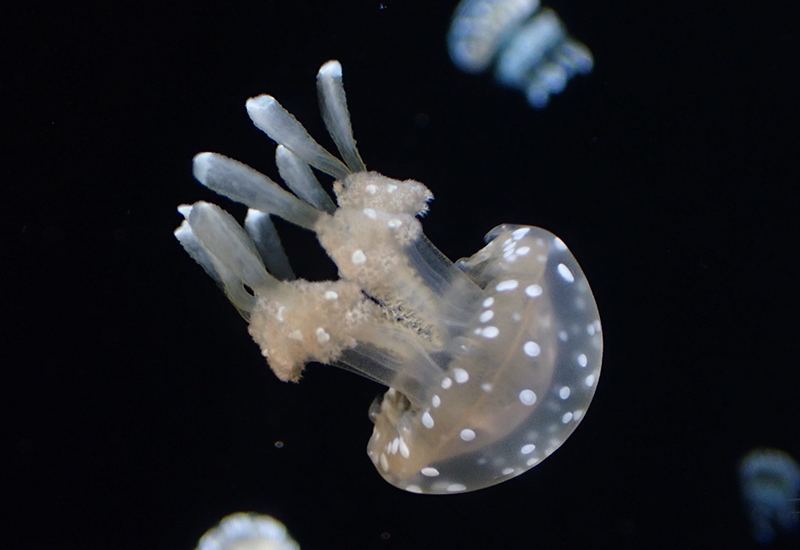
Octopus jellyfish on displayThe life cycle of the spotted jellyfish begins with a fertilized egg hatched from the parent, which develops into an oval-shaped "planula" about 0.2 mm in length. The planula swims around, and once it finds a place to attach itself, it becomes a "polyp" that resembles a sea anemone. As the polyp grows, it gradually changes its appearance due to increased energy or stimulation, becoming a state called a "strobila." This strobila has a shape that looks like a jellyfish larva, called an "ephyra," attached to the end of the polyp.
In many species, multiple ephyrae can be produced from a single polyp at one time, but in the jellyfish species *Octopus jellyfish*, only one ephyra can be produced from a single polyp. When the ephyra separates from the strobila and develops, it becomes the adult form that you are familiar with.
To prepare for breeding, we first attached the polyps that were growing in the display tank to a net to make them easier to manage, and then transferred them to a container.
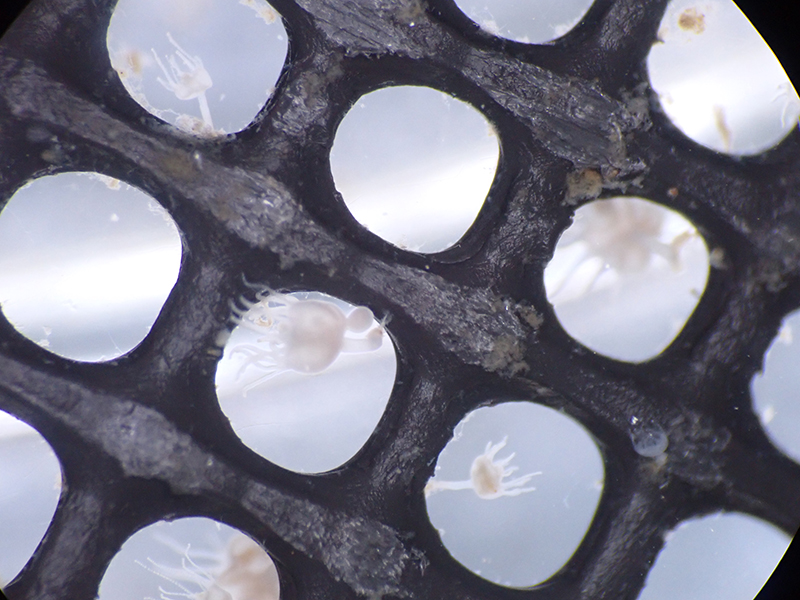
Polyps of a jellyfish (each square in the net is 2mm square)I fed the polyps Artemia and rotifers as food. As a result, they gradually grew larger and I was able to produce ephyrae.
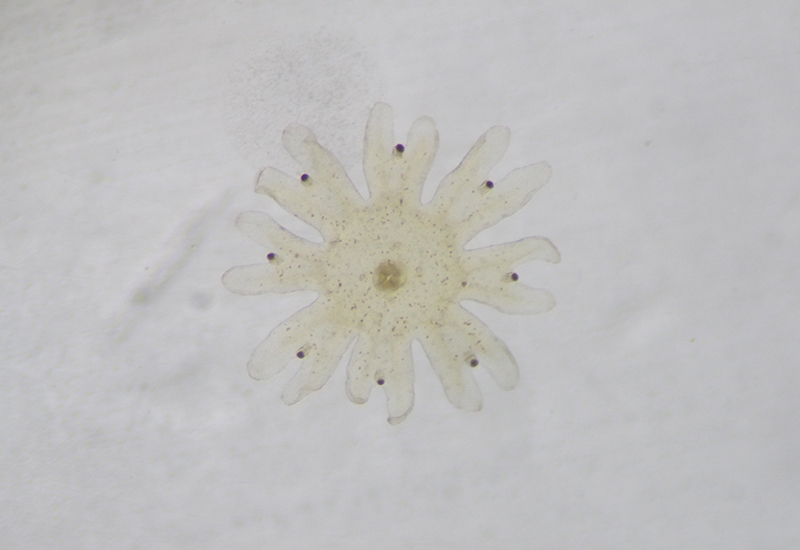
Ephyra of the jellyfish (approximately 2mm in overall diameter)This is where the problem began. I had previously tried to breed jellyfish, but they wouldn't grow beyond the ephyra stage. So I decided to try various rearing methods. First, I tried raising them without any water flow, but they sank and died immediately. So this time, I created a water flow using air to prevent them from sinking, and they grew rapidly, reaching a size of about 1 cm in diameter!
However, only a few out of dozens of individuals grew to adulthood. So, next, I increased the size of the tank and changed the Artemia food to a more nutritious type. And then... almost all of the ephyra grew to adulthood!
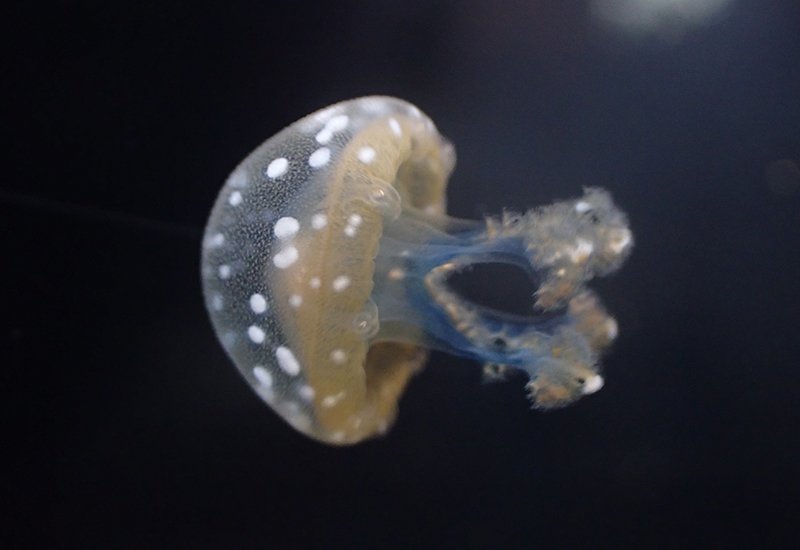
A jellyfish (with a bell diameter of approximately 2 cm) being kept in the back area.In this way, we were able to exhibit the jellyfish that were born in the park.
However, there are still challenges, such as some individuals having irregularly shaped umbrellas or lacking appendages (the rod-shaped parts at the ends of the oral arms). We will continue to devise ways to overcome these challenges and ensure stable breeding.
[Tokyo Sea Life Park]
◎Related articles
・
We exhibited jellyfish. (October 1, 2010)
・
A new face in the "Floating Organisms" section: the octopus jellyfish. (November 2, 2018)
・
Efforts to maintain the exhibit: breeding and rearing (February 24, 2023)
(February 14, 2025)