At Tokyo Sea Life Park, the particularly large "South China Sea" tank, located immediately upon entering the "World's Oceans" area, displays a variety of fish of all sizes that inhabit that region. This time, we'll introduce their efforts to exhibit two Humphead Wrasse together.
You might not be very familiar with the name "Humphead Wrasse Wrasse," but many people are probably familiar with its other name, "Napoleonfish." It is also known as a fish that can change sex; after maturing as a female, the larger individuals in the group will become males.
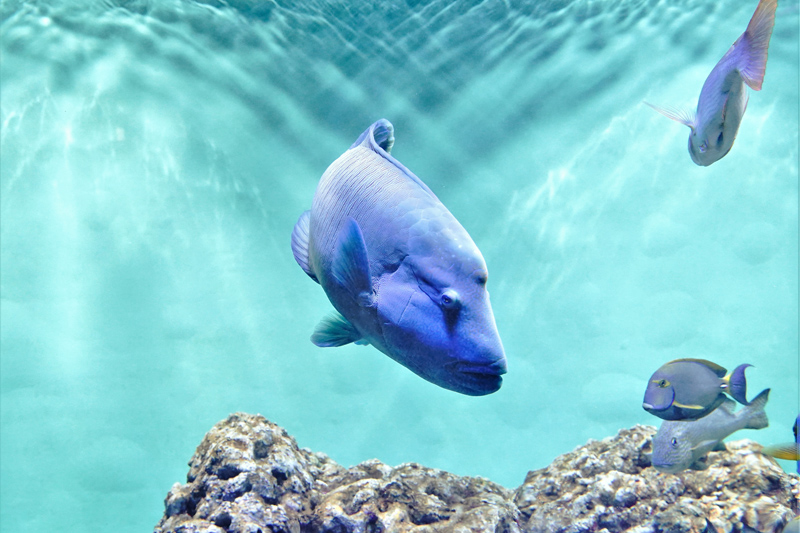
Humphead WrasseHumphead Wrasse is the world's largest wrasse species, growing up to 2 meters in length. In the wild, it is classified as endangered (EN) by the International Union for Conservation of Nature (IUCN) due to overfishing and habitat destruction.
Tokyo Metropolitan Zoos and Aquariums have formulated the "
Zoo Stock Plan" to protect and breed rare animals that they keep and exhibit. This species was selected as one of the species included in the plan, and two individuals were placed together with the aim of breeding them. There were two challenges to overcome in this endeavor.
First, let's talk about cohabitation with other creatures. In the "South China Sea" tank, until last year we exhibited one 100cm-long Humphead Wrasse wrasse and two giant grouper, a type of eel, about 150cm in length. Previously, when we put a 60cm-long Humphead Wrasse into the tank, it was chased around by the giant grouper and the existing fish, so we temporarily moved it to the back area.
Unfortunately, the resident fish later died. We then moved one of the giant groupers, which had been particularly aggressive, to the back room to prepare for cohabitation in this tank.
Next, we have to consider fighting amongst themselves. Since Humphead Wrasse can engage in fierce fights with other members of the same species, we decided to put two individuals, including the 60cm specimen mentioned earlier that was being prepared for display in the back area, into the tank at the same time, hoping to minimize any interference between them.
As a result, they seemed somewhat concerned about each other, but they didn't fight. Although they showed signs of being concerned about the giant grouper, the giant grouper didn't chase after the newcomers.
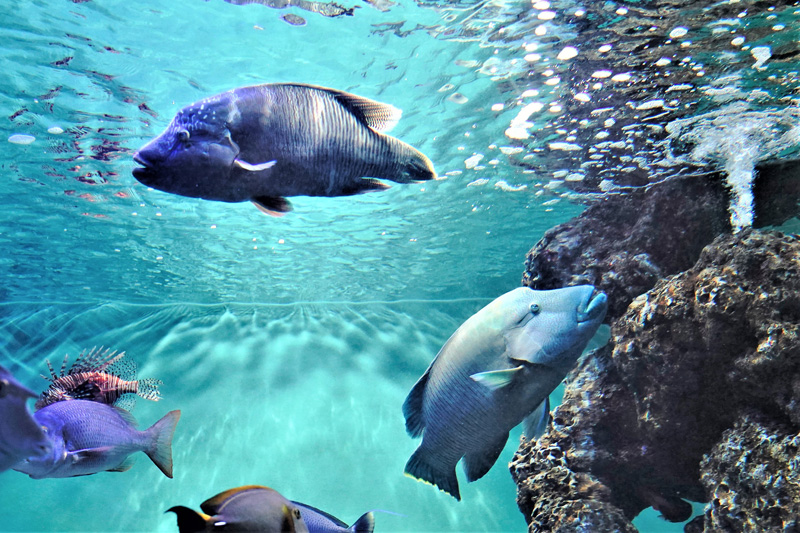
Two fish swimming around in the tankCurrently, both of Humphead Wrasse are eating well, and you can see them swimming around in the tank.
I don't know which of the two I've put together will be the male, but I plan to continue raising them healthily so that I can one day see them spawn in the tank.
[Tokyo Sea Life Park]
(October 29, 2021)