At Tokyo Sea Life Park various methods are used to collect organisms for display. This time, we will introduce one of the methods used to collect organisms for display in the "Deep Sea Area": bottom trawling.
Bottom trawling is a fishing method in which a large, bag-shaped net is dropped to the seabed and dragged along the bottom. We board bottom trawling boats from winter to spring, when the surface water temperature cools down and the difference between it and the deep sea temperature becomes smaller.
We set sail before sunrise, while it's still dark, and head towards our collection point, which is about 200-300 meters deep. Once we arrive, we cast the net into the sea from the stern of the boat and let it sink to the bottom. After confirming that it has reached the bottom, we slowly move the boat forward and tow the net. While towing the net, there is a unique "swaying" motion on board, and many of the staff suffer from seasickness. Even I, who was confident in my ability to handle boats, remember getting terribly seasick the first time I was on board, and how miserable it was. In my hazy state of mind, a senior colleague encouraged me by saying, "It's okay to throw up, just keep moving your hands!" which is now a fond memory.
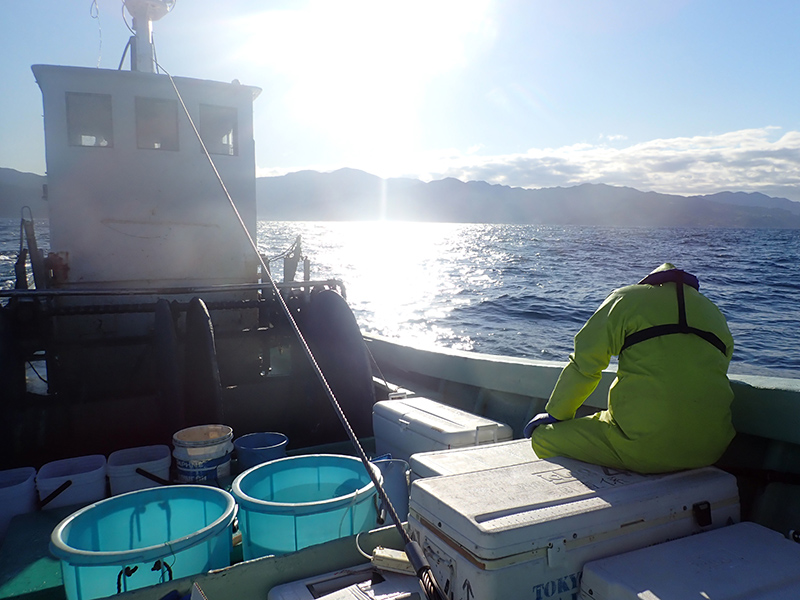
Bottom trawling, which tends to be disrupted by its unique swaying motion,After pulling the nets onto the boat, the contents of the net bags are transferred to containers filled with seawater, and the organisms that we want to display are selected.
At this time, because there are many creatures in the tank, they may injure each other, so it is important to quickly find soft and delicate creatures such as flapjack octopuses and sea cucumbers and carefully scoop them up along with the water. After placing them in the tank for storage, seawater ice is floated on top to keep the water temperature low and prevent it from rising.
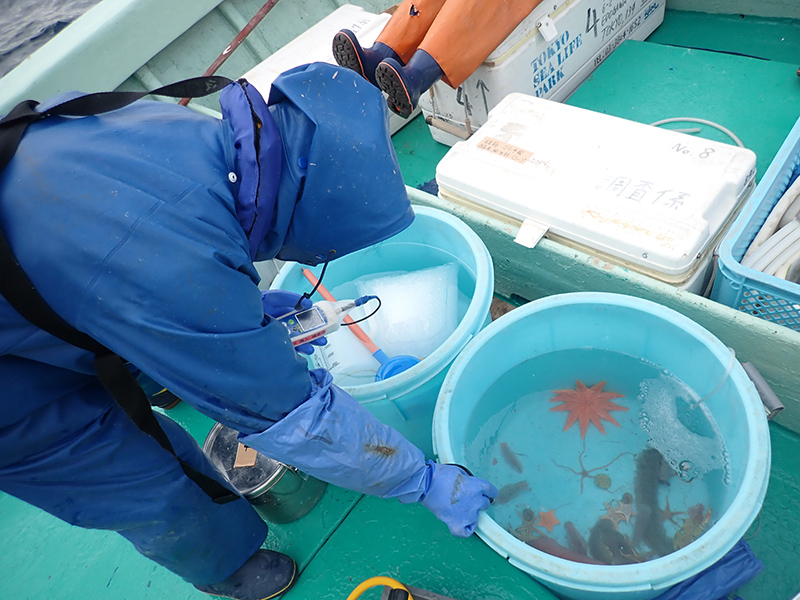
Use sea ice to keep the water temperature low.Furthermore, some of the collected organisms, such as the red slugfish, have their swim bladders inflate due to the sudden change in water pressure, making them unable to swim properly.
In such cases, a special metal tank capable of applying water pressure (pressure tank) is used. After pressurizing, the pressure is gradually reduced to treat the fish so that it can swim normally even under atmospheric pressure.
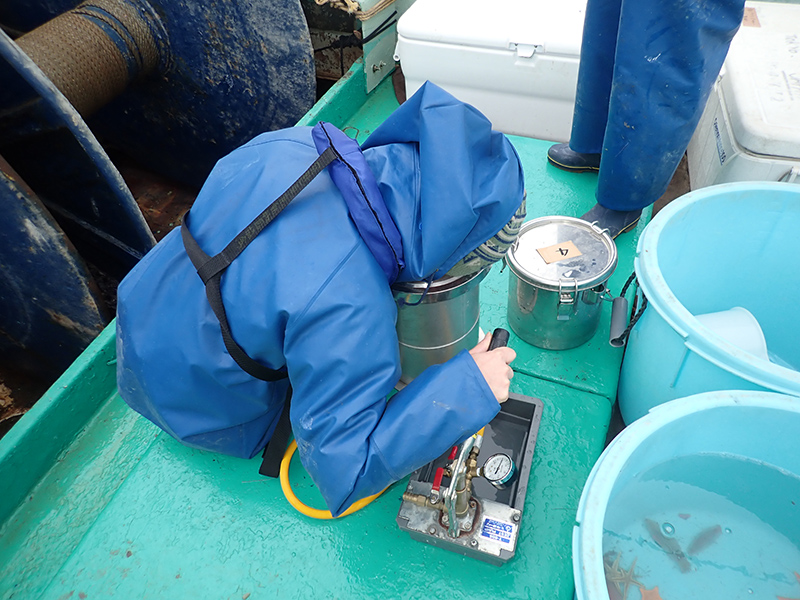 | 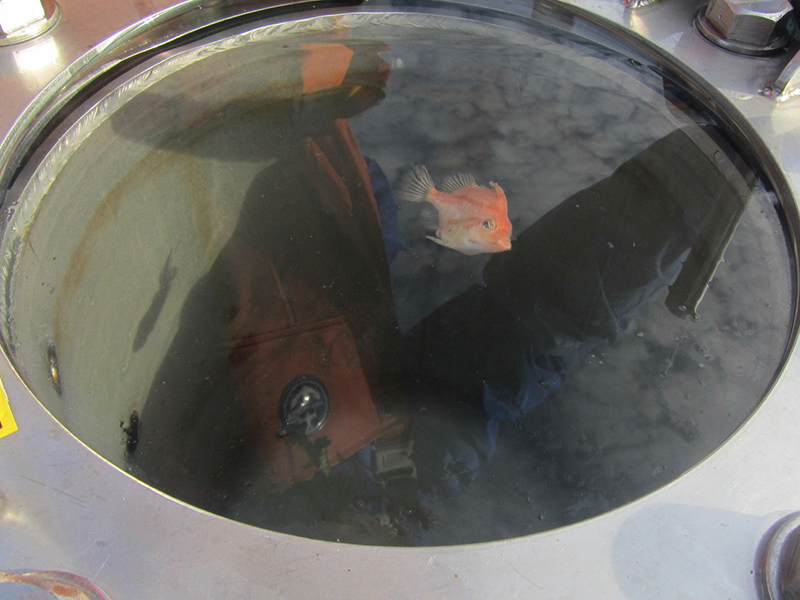 |
| Fish that float to the surface are treated with pressure therapy in a pressure tank. | Successful treatment of red barnyard grass |
Bottom trawling requires quick responses to each organism caught, but it's a very enjoyable way to collect deep-sea creatures that are rarely seen elsewhere. You get excited with each net you bring up, wondering what interesting creatures you'll find (apart from seasickness).
We are planning to collect specimens using bottom trawling again this winter. Please look forward to the "Deep Sea Area" exhibit.
[Yusuke Ogawa, Animal Care and Research Officer, Tokyo Sea Life Park]
(January 7, 2022)