In the "Deep Sea Creatures 1" tank in the World of the Oceans area of Tokyo Sea Life Park, deep-sea creatures, mainly invertebrates such as the spiny hermit crab, the bird's foot, and the mussel clam, are on display.
This time, we'll introduce the "horned pufferfish," which is characterized by a pair of sharp, horn-like spines on its head.
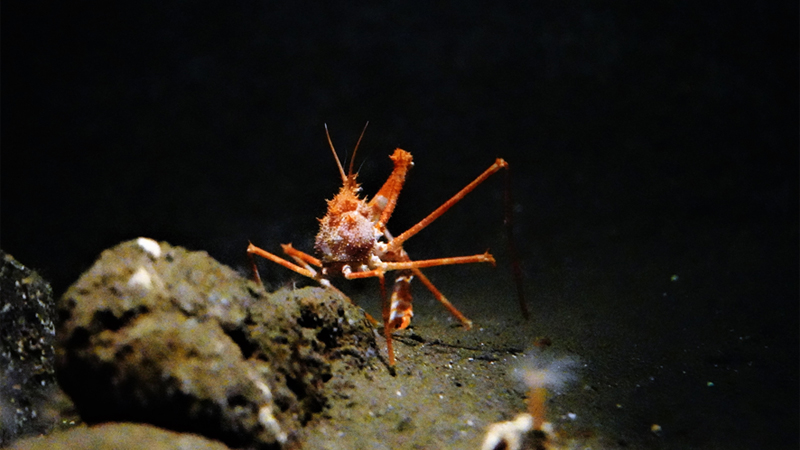
Horned pufferfishWhen you hear the word "porcupinefish," you might think of the pufferfish that puffs up into a round shape, but the horned porcupinefish is a type of crab belonging to the family Majidae that mainly inhabits the deep sea.
This creature inhabits sandy or muddy bottoms at depths of approximately 40 to 300 meters, and its carapace length is about 3.5 cm, with a leg span of about 20 cm. As its name suggests, its body is covered in many spines, and its body color is reddish. While it stands out in bright places, the red color is absorbed by the surface layer of the sea, making it appear dark and inconspicuous in the deep sea. Therefore, for deep-sea creatures, the red color makes it difficult to be spotted by predators, thus protecting them from being seen.
At the aquarium, we've been given the opportunity to ride on a fisherman's deep-sea trawling boat and are displaying the items they've collected. You can see what it was like
in this article.
Many deep-sea creatures are often weakened and damaged by changes in water pressure and fishing nets when brought to the surface, but crustaceans are said to be relatively stronger than fish. The porcupinefish also seems to be resistant to changes in water pressure, and a few days after being brought to the aquarium alive, it starts eating vigorously.
Some species of crabs are aggressive, so caution is needed when keeping them with other creatures. However, the porcupinefish usually stays still, clinging to the substrate or walls, and rarely attacks other creatures, so it can be kept with a variety of other organisms.
On the other hand, when they notice food, they grab it with both claws in a speed that is unimaginable from their usual movements, and then skillfully use their claws to bring it to their mouths and eat it.
The deep-sea tanks are dimly lit to minimize stress on the creatures, so they may be difficult to spot, but when you visit, please be sure to look carefully on the sand and walls to observe them.
[Tokyo Sea Life Park]
(February 13, 2022)