|
Here it is, Western Barn Owl
└─2007/07/20 |
|
|
|
|
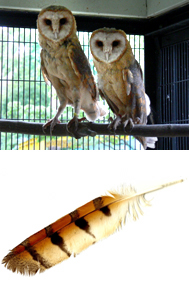
In a small exhibit area just before the "Guinea Pig Corner" at Inokashira Park Zoo, you can see rabbits and Western Barn Owl. Two of the Western Barn Owl came from Higashiyama Zoo and Botanical Gardens in Nagoya and made their debut in March 2007.
By the way, what image comes to mind when you think of Ural Owl? A stocky, brown body with a flat face and big eyes...? Or perhaps a snowman-like white body with sharp yellow eyes? However, Western Barn Owl looks quite different from what we typically consider Ural Owl. It has a clearly defined facial disc made of stiff feathers that surrounds its eyes, and it has round, black eyes and Kawakawa body. From the front, it appears white, while from the back, a light brown, withered grass color is prominent.
When we first started exhibiting them, they were completely unfamiliar with the exhibit area and people, and would stay in their nest boxes all the time. So we tried various things, like adding more perches and extending the cleaning time to help them get used to people, and eventually they were able to stay on the perches calmly for short periods of time. Even so, they still stay in their nest boxes except when staff are coming and going. If things continue like this, it will be difficult for visitors to see them.
Also, it's molting season now. Western Barn Owl naturally prefer confined spaces, but if they stay inside the nest box all the time, their feathers might not molt properly. So, I added more perches, and they seemed to perch much more comfortably outside the nest box, so I decided to put a lid on the nest box. Now I can see them up close more than before.
Ural Owl are covered in soft feathers so that they can move silently. Their flight feathers have serrated edges, giving them a soft, velvety surface. (These serrations help to streamline airflow, allowing them to move quietly.) This allows them to approach prey unnoticed and to clearly hear surrounding sounds while moving.
During molting season, owls shed feathers with every movement, and these feathers can get stuck on the netting in the exhibit room. Molting season is a great opportunity to observe Ural Owl feathers!
With the addition of Western Barn Owl, which inhabit grasslands and open woodlands, there are now three species of Ural Owl that can be seen at Inokashira Park Zoo. The other two species are Ural Owl in the "Wild Bird Forest" and Eurasian Eagle Owl in the "Small Mammal House." Be sure to compare the differences in their colors and sizes.
[Masaki Mifune Inokashira Park Zoo]
Photo above: Western Barn Owl
Photo below: Western Barn Owl flight feathers
(July 20, 2007)
|
|
|

|

)