Added on September 25, 2022:
The gender has been determined, and a name has been decided. The gender is male, and the name is "Toto".
A Japanese Serow serow was born at Inokashira Park Zoo on Wednesday, July 6, 2022. Its sex is not yet known.
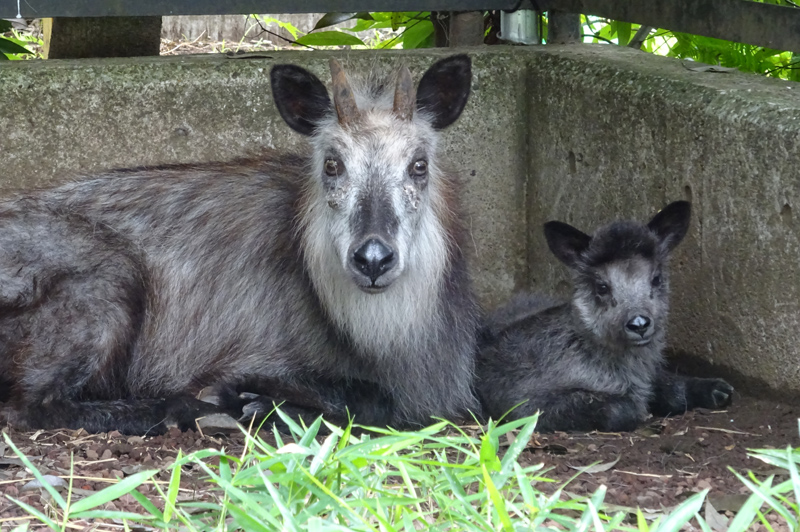
Japanese Serow "Suzuna" and her offspringOn November 8, 2021, "Suzuna" (female) arrived at our zoo from Higashiyama Zoo and Botanical Gardens in Nagoya City and paired with "Mumu" (male). Mating behavior was observed at the end of 2021, and we continued to observe them in anticipation of giving birth that summer. On July 5, 2022, we noticed a change in Suzuna's behavior, and the next day, the zookeepers confirmed that she had given birth in the enclosure. This is the first breeding at our zoo in approximately nine years, since 2013.
Japanese Serow is a rare animal endemic to Japan and designated as a special natural monument. Therefore, the Japanese Association Japanese Association of Zoos and Aquariums (JAZA) created the "Japanese Serow Management Plan" with the goal of increasing the captive population through breeding while maintaining genetic diversity. Zoos throughout Japan have been cooperating in this plan to promote breeding. As part of this plan, Suzuna arrived at our zoo, formed a new pair with Mumu, and we have been working towards breeding. Therefore, this successful breeding is a very valuable achievement.
Furthermore, Suzuna and Mumu's first breeding was achieved at a considerably advanced age. The average age for the first breeding of Japanese Serow kept in captivity in Japan is approximately 3 years and 11 months for both males and females, and the average age for all breeding cases is approximately 7 years and 3 months for both males and females. In contrast, Suzuna was 11 years old and Mumu was 8 years old, indicating that their first breeding was achieved at a considerably advanced age. This is a successful example of pairing Japanese Serow and is expected to be useful in future management plans for pairing.
Suzuna, the mother, is giving birth for the first time, but she seems very calm, constantly staying close to her baby and breastfeeding. Currently, she is caring for her baby in an area close to visitors, so we have set up a barrier to keep people away from the viewing area. You may not be able to see the baby at times, but for the time being, please quietly and gently watch over her from a distance.
Current status of animal care at our zoo (as of July 8, 2022)3 individuals (1 male, 1 female, 1 of unknown gender) *This includes the offspring born this time.
Breeding situation in Japan (as of December 31, 2021)18 zoos/aquariums, 52 animals (24 males, 28 females)
Source: 2021 Japanese Serow Domestic Pedigree Registry [Japan Japanese Association of Zoos and Aquariums]
◎Related News
・
A female Japanese serow named "Suzuna" has arrived at the zoo from Japanese Serow Zoo and Botanical Gardens in Nagoya City. (November 11, 2021)
(July 8, 2022)
(September 25, 2022: Added information regarding the determination of gender and name)