|
March 24th - Participants Wanted! Towards Wildlife Conservation -Tokyo Zoological Park Society Wildlife Conservation Fund Report and Lecture, Themes: Shoebill, African Grey Parrot, Aye-aye, Colugo, First-come, first-served basis! (*Registration is now closed)
└─2019/03/03 |
|
|
|
Update: March 6, 2019 (Wed) 14:20. Registration is now closed as we have reached full capacity. Thank you for your applications.
=====
Tokyo Zoological Park Society Wildlife Conservation Fund provides grants to support the activities of those engaged in wildlife conservation. To raise awareness of conservation activities that have received grants, we will be holding a report lecture. The venue will be at Ueno Zoo.
There will be four lectures this time. The conservation animals are Shoebill, African grey parrot, Aye-aye, and Malayan colugo. Applications will be accepted on a first-come, first-served basis. Please apply early!
Date and time of event / LocationDate and Time: Sunday, March 24, 2019, 1:15 PM - 4:15 PM (tentative)
Location: 3rd floor of the management office inside Ueno Zoo
80 people
Lecture 1: Physiological state and behavioral patterns of Shoebill– Towards breeding in captivity Lecturer: Tetsushi Kusuda (Associate Professor, Faculty of Applied Biological Sciences, Gifu University)
The wild Shoebill population has halved compared to the 1990s due to habitat development and other factors. Only a few cases of captive breeding have been reported in Europe and North America, and their physiology and ecology remain largely unknown. While only 40 shoebills were reported to be kept in captivity worldwide as of 2013, 17 were being kept in Japan as of the end of 2016. This presentation will discuss the changes in secretion and behavior resulting from annual sex hormone analyses conducted to determine the optimal timing for cohabiting males and females in an effort to breed Shoebill.
◎Lecturer Profile: Associate Professor, Faculty of Applied Biological Sciences (Animal Reproduction Laboratory), Gifu University. External member of the Biodiversity Committee Japanese Association of Zoos and Aquariums. Specializes in zoo animal reproduction. In collaboration with zoos and aquariums nationwide, conducts research on reproductive physiology and behavior, mainly focusing on mammals, birds, and reptiles. Strives to conduct research that is useful for actual breeding. Also participates in conservation activities for the rare native Japanese Pond Turtle and the Kasumi salamander, and is in charge of ex-situ conservation. | 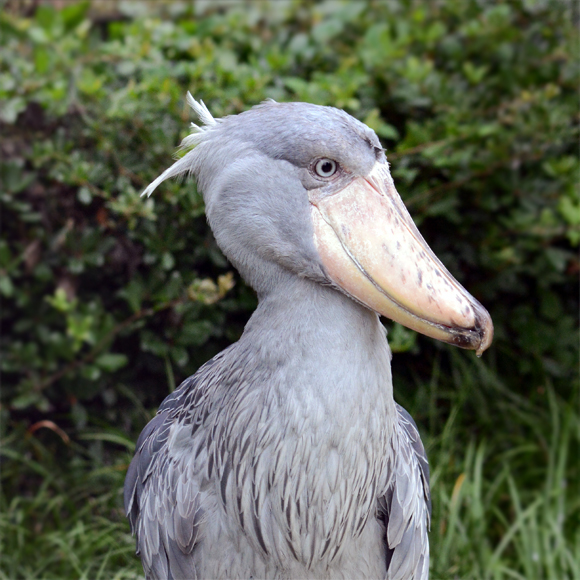
Shoebill at Ueno Zoo |
Lecture 2: Strategies for the reintroduction of wild African Grey Parrots into the wild and the prevention of poaching. Lecturer: Tomoaki Nishihara (Board Member, Africa Japan Council, a specified non-profit organization)
African Grey Parrots, native to the tropical rainforests of central Africa, are experiencing a significant decline in population due to increasing international demand as pets, leading to illegal capture and international illicit trade. The high mortality rate after capture is further exacerbating the decline. The speaker has worked on rehabilitating individuals seized in the Republic of Congo, successfully releasing 221 birds back into the wild with the cooperation of veterinarians. The speaker will also discuss the current situation of African Grey Parrots and conservation efforts, including the construction of breeding facilities in the region and public awareness campaigns in Japan through leaflets and lectures.
◎Lecturer Profile: For approximately 30 years since 1989, he has been engaged in wildlife research and surveys, national park management, and tropical forest and biodiversity conservation in the tropical rainforest regions of Central Africa, including the Republic of Congo and Gabon. He is a natural environment conservation researcher at WCS (Wildlife Conservation Society), an international conservation NGO. He is also a board member of the NPO Africa-Japan Council. He graduated from the Department of Human Evolutionary Studies, Faculty of Science, Kyoto University, and holds a PhD in Science. His current interests include maintaining a balance between human use of nature and cultural heritage, and the future of indigenous peoples. | 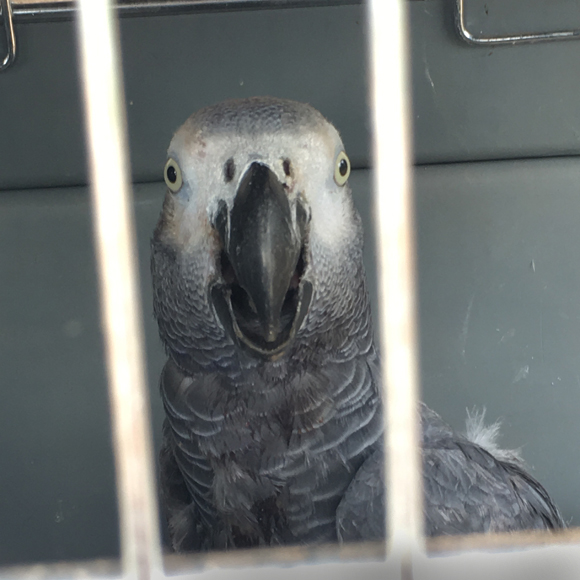
African Grey Parrot captured by poachers (Photo courtesy of Tomoaki Nishihara) |
Lecture 3: Investigating Prosimians in Northwestern Madagascar – The Habitat Status of Aye-aye Lecturer: Taizo Shima (Representative of Japan Aye-aye Fund)
Madagascar boasts extremely high primate diversity, home to approximately 100 species of prosimians belonging to five families. In particular, the northwestern region, stretching from the southern to western Tsaratanana Massif, including the transition zone from arid forests to the Sambiranu forest, is a noteworthy area for prosimian life due to its diverse environments of arid and humid regions. Field research has confirmed the presence of Aye-aye Aye-aye and revealed that its overnight travel, including ground travel, can reach up to 1 km. I will discuss Madagascar's natural environment and future prospects.
◎Lecturer Profile: Graduated from the Department of Anthropology, Faculty of Science, University of Tokyo. Doctor of Science. Chevalier, 5th Class, of the Order of Madagascar. Numerous papers and books published. In 1984, participated in the world's first filming Aye-aye. Since then, has been dedicated to the study of Aye-aye. From 1990 to 2001, stayed at the Tsimbazaza Zoological and Botanical Garden in Madagascar for a total of 6 years and 3 months as a specialist dispatched by the Japan International Cooperation Agency. In January 2002, established the Japan Aye-aye-Aye Fund and became its representative. In August 2002, became Honorary Chairperson of the Madagascar Aye-aye-Aye Fund. | 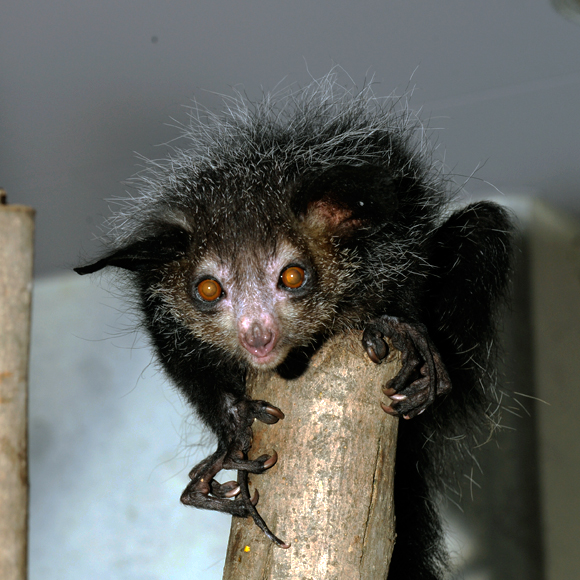
Aye-aye at Ueno Zoo |
Lecture ④ Towards the conservation of the Malayan colugo in Indonesia: What we've learned about their gliding ability Lecturer: Yamato Tsuji (Assistant Professor, Primate Research Institute, Kyoto University)
The Malayan colugo is endemic to Southeast Asia. Although its name includes "monkey," it is not a primate but a dermatomorpha (dermoptera). It has the unusual characteristic of gliding through trees by spreading its gliding membrane. The forests where colugos live are continuously decreasing, but there is not much basic information about their ecology. I reported on colugo research at this lecture in the past two years, but this time I will focus on what we have learned about the colugo's gliding ability.
◎Lecturer Profile: Currently an Assistant Professor in the Social Ecology Division of the Primate Research Institute, Kyoto University. His main research theme is the impact of seasonal and annual changes in habitat on primate ecology. He has conducted research on foraging ecology and interspecies relationships in primates such as Japanese Macaque and leaf monkeys, medium-sized carnivorous animals in the suburbs of Tokyo, and wild animals in Indonesia. | 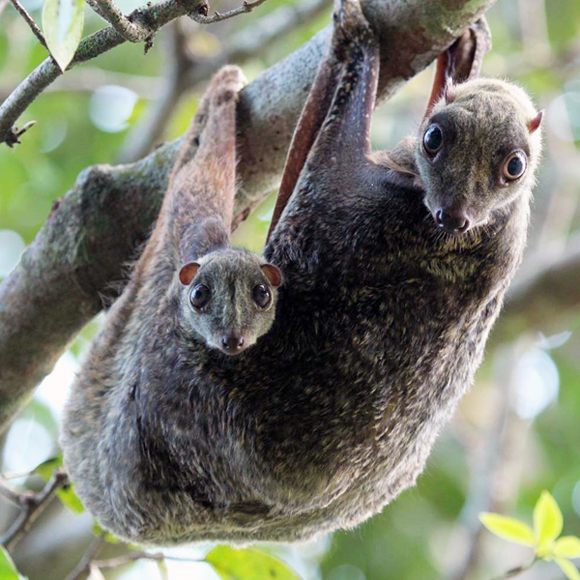
Malayan colugo (Photo courtesy of Yamato Tsuji) |
How to apply Update: As of 2:20 PM on Wednesday, March 6, 2019, registration has closed as the maximum number of participants has been reached.
(Email address has been hidden)Please apply by email to the address provided. Applications will be accepted on a first-come, first-served basis. The subject line of your email should be "Conservation Fund Lecture 2019," and in the body of the email, please include ① your name (with phonetic spelling), ② your age, ③ your email address, and ④ your phone number ( address is not required). After your application is received, we will send you a participation guide as an email attachment. We kindly ask that you print it out and bring it with you (admission to the park will be free).
You can apply for multiple people in one application. In that case, please provide the following information for everyone except the representative: ① Name (with phonetic spelling) and ② Age.
- Applications will be accepted on a first-come, first-served basis, and we will announce on this page that applications have been closed once the capacity is reached.
⇒Update: March 6, 2019 (Wed) 14:20. Registration is now closed as we have reached full capacity. Thank you for your applications.
We sent a PDF of your participation certificate via email around 6:30 PM on Wednesday, March 6th. If you have not received the email or do not have access to a printer, please contact us at the phone number or email address provided during registration.
- Please configure your spam filter settings to allow emails from @tokyo-zoo.net and @tzps.or.jp to be received.
- The personal information you provide when applying will be used solely for contacting you regarding this event. Furthermore, we will strictly manage your personal information, including data storage and deletion.
inquiryTokyo Zoological Park Society Wildlife Conservation Fund Office: 03-3828-8235
(March 3, 2019) (March 6, 2019: Registration closed as the maximum number of participants was reached)
|
|
|
|