*Applications are now closed. Thank you for your applications.
Tokyo Zoological Park Society Wildlife Conservation Fund provides grants to support the activities of those engaged in wildlife conservation. To raise awareness of conservation activities that have received grants, we will be holding a report lecture. The venue will be at Ueno Zoo.
There will be four lectures. The conservation animals covered are the Malayan colugo, Asian Black Bear, Japanese bunting, and Tsushima Leopard Cat. Registration is on
a first-come, first-served basis. Please register early!
Date and time of event / Location
Date and time: March 26, 2017 (Sunday) 13:15-16:15
Location: 3rd floor of the management office inside Ueno Zoo
80 people
Lecture 1: Towards the Future of the Malayan Colloquium – Unraveling its Basic Ecology Through Field Research
Lecturer: Yamato Tsuji (Assistant Professor, Primate Research Institute, Kyoto University)
The Malayan colugo is a species endemic to Southeast Asia. It belongs to the order Dermoptera, not Primates. It has the unusual characteristic of gliding through trees by spreading its gliding membrane. The forests where colugos live are continuously shrinking, but there is currently little basic information about them. I will talk about what we have learned from our research in Indonesia and the future of colugos.
◎Lecturer Profile: Currently an Assistant Professor in the Social Ecology Division of the Primate Research Institute, Kyoto University. His main research theme is the impact of seasonal and annual changes in habitat on primate ecology. He has conducted research on foraging ecology and interspecies relationships in primates such as Japanese Macaque and leaf monkeys, medium-sized carnivorous animals in the suburbs of Tokyo, and wild animals in Indonesia. | 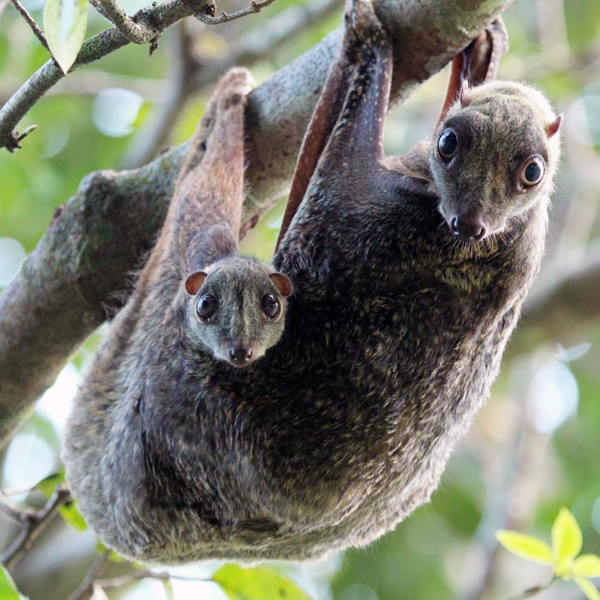
Photographed by Yamato Tsuji |
Lecture 2: Saving the Asiatic Asian Black Bear of Shikoku from Extinction – Kinship Analysis through Genetic Analysis
Lecturer: Takaki Yamada (Researcher, Shikoku Natural History Science Research Center, a certified non-profit organization)
The Ministry of the Environment's Red List lists five regional populations of Asian Black Bear as "regionally endangered populations." Of these, the population in Shikoku is the most at risk of extinction, with an estimated population of fewer than 50 individuals. The Shikoku Natural History Science Research Center conducts research and various activities to conserve Asian Black Bear. This report will cover the kinship relationships and inbreeding status revealed by genetic analysis.
◎Lecturer Profile: Graduated from the Department of Wildlife Research, Tokyo College of Environmental Engineering. Currently a Senior Researcher at the Shikoku Natural History Science Research Center, a certified non-profit organization. After working as a temporary employee at the Ishikawa Prefectural Nature Conservation Center and a contract employee at the Natural Environment Research Center, he has been in his current position since 2011. He has been engaged in research on Asian Black Bear in Ishikawa and Iwate prefectures, and is currently conducting ecological surveys and conservation activities for Asiatic Asian Black Bear in Shikoku. | 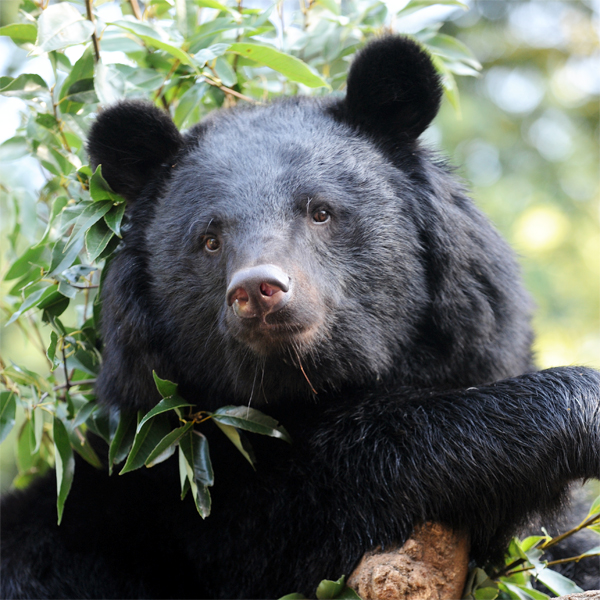
Asian Black Bear at Ueno Zoo |
Lecture 3: Exploring the breeding environment of the Japanese bunting – Habitat survey in Yamanashi, Nagano, and Niigata prefectures
Lecturer: Kyohei Nishi (Part-time lecturer at Tsuru University)
The Yellow-breasted Bunting, listed as near-threatened in the Ministry of the Environment's Red Data Book, is a migratory bird of the bunting family that visits Japan in the summer. Currently, its breeding grounds are known to be limited to Japan. The presenter discovered Llama Buntings inhabiting a larch plantation in eastern Yamanashi Prefecture. Until now, most known breeding grounds for Yellow-breasted Buntings have been secondary forests. Why do Yellow-breasted Buntings live in coniferous plantations, which are thought to have low biodiversity? We will present the results of basic research.
◎Lecturer Profile: Completed a Master's program at Tsuru University Graduate School, and is currently a part-time lecturer at the same university. Since 2001, has been conducting bird research in Yamanashi Prefecture. His field of study is the northern foothills of Mt. Fuji, where he mainly conducts research on the distribution and ecology of forest birds. Since 2003, he has also been conducting research on the Asian House Martin, and since 2009, on the Spotted Nutcracker. He is a collaborating researcher for bird banding surveys at the Yamashina Institute for Ornithology and a protection monitor for rare wild animals and plants in Nagano Prefecture. | 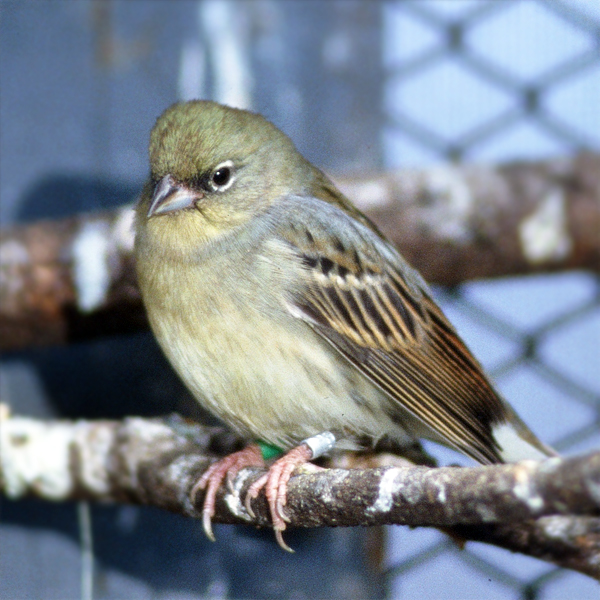
Yellow-breasted bunting in captivity |
Lecture 4: Reproductive Physiology of Tsushima Leopard Cat– Efforts toward Conservation
Lecturer: Tetsushi Kusuda (Associate Professor, Faculty of Applied Biological Sciences, Gifu University)
Tsushima Leopard Cat is the most endangered mammal in Japan. Zoos are working to breed them in captivity in cooperation with the Ministry of the Environment's conservation and breeding program, but breeding is not easy. Furthermore, many aspects of their reproductive physiology remain unknown, and efforts are being made to improve breeding by clarifying these aspects. This presentation will outline the physiological surveys, pregnancy testing, and artificial insemination research using Amur Leopard Cat that are being conducted in collaboration with facilities that keep this species.
◎Lecturer Profile: Associate Professor, Faculty of Applied Biological Sciences (Animal Reproduction Laboratory), Gifu University. External member of the Biodiversity Committee Japanese Association of Zoos and Aquariums. Specializes in zoo animal reproduction. In collaboration with zoos and aquariums nationwide, conducts research on reproductive physiology and behavior, mainly focusing on mammals, birds, and reptiles. Strives to conduct research that is useful for actual breeding. Also participates in conservation activities for the rare native Japanese Pond Turtle and the Kasumi salamander, and is in charge of ex-situ conservation. | 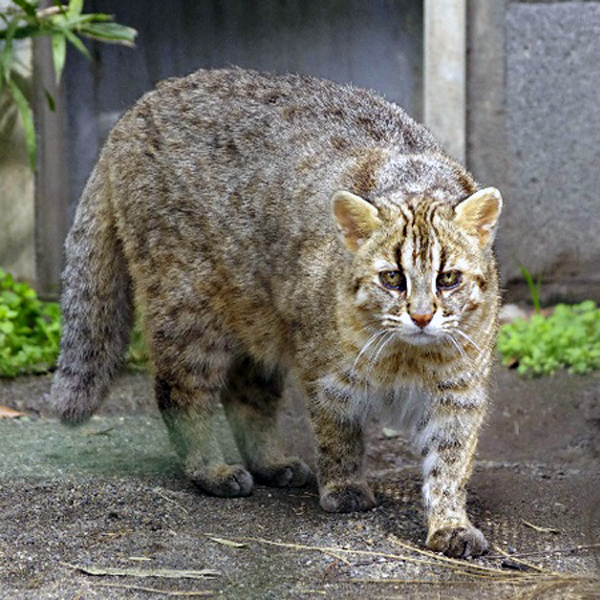
Tsushima Leopard Cat Inokashira Park Zoo |
How to apply
*Applications are now closed. Thank you for your applications.
Please apply by email to
hozen2017@tokyo-zoo.net. Applications will be accepted on
a first-come, first-served basis. The subject line of your email should be "Conservation Fund Lecture 2017," and in the body of the email, please include
① your name (with phonetic spelling), ② your age, ③ your email address, and ④ your phone number (address is not required). After your application is received, you will receive a participation guide that will serve as your admission certificate
by email (admission to the zoo will be free. We apologize for the inconvenience, but please print out the participation certificate that will be sent as an email attachment and bring it with you).
You can apply for multiple people in one application. In that case, please provide the following information for everyone except the representative: ① Name (with phonetic spelling) and ② Age.
*Applications will be accepted on a first-come, first-served basis, and we will announce on this page once the capacity is reached.
*Participation certificates will be sent to all registered participants via email at a later date (they will not be sent out individually).
*We will also notify you if you become ineligible due to the timing of your application.
(Please adjust your spam filter settings to allow emails from @tokyo-zoo.net and @tzps.or.jp to be received.)
*The personal information you provide when applying will only be used for communication regarding this event.
Furthermore, we will strictly manage personal information, including data storage and deletion.
inquiry
Tokyo Zoological Park Society Wildlife Conservation Fund Office: 03-3828-8235
(March 8, 2017)