|
March 24th - Participants Wanted! Towards Wildlife Conservation -Tokyo Zoological Park Society Wildlife Conservation Fund Report and Lecture, Theme: Prosimians such as the Okinawa Rail, Colugos, and Aye-aye (Registration closed on March 12th)
└─2018/03/02 |
|
|
|
Update: March 12, 2018 (Monday) 19:45. Registration is now closed as we have reached full capacity. Thank you for your applications.
=====
Tokyo Zoological Park Society Wildlife Conservation Fund provides grants to support the activities of those engaged in wildlife conservation. To raise awareness of conservation activities that have received grants, we will be holding a report lecture. The venue will be at Ueno Zoo.
There will be three lectures this time. The conservation targets are the Okinawa Rail, the Malayan Colloquium, and prosimians, mainly Aye-aye. Registration is on a first-come, first-served basis. Please register early!
Date and time of event / LocationDate and time: Saturday, March 24, 2018, 13:30-16:00
Location: 3rd floor of the management office inside Ueno Zoo
80 people
Lecture 1: Returning the Okinawa Rail to the Wild – An Attempt at Release to Avoid Extinction Lecturer: Takaya Kinjo (NPO Animal Hospital Okinawa)
Since its discovery in 1981, the Okinawa Rail's population has plummeted to around 700 individuals. Government, private sector, and local residents have worked together to save the Okinawa Rail. Currently, the population has recovered to approximately 1,500 individuals. However, the situation remains dire, and it is difficult to say that extinction has been averted. I will discuss the timing of releases and the training required for release, based on insights gained from attempts to release captive-bred individuals into the wild.
◎Lecturer Profile Born in Okinawa Prefecture. Graduated from the Faculty of Life and Environmental Sciences, Teikyo University of Science. Since 2013, has worked at the specified non-profit organization Animal Hospital Okinawa, serving as a researcher in the Wildlife Conservation Research Department, responsible for in-situ conservation of species such as the Okinawa Rail. | 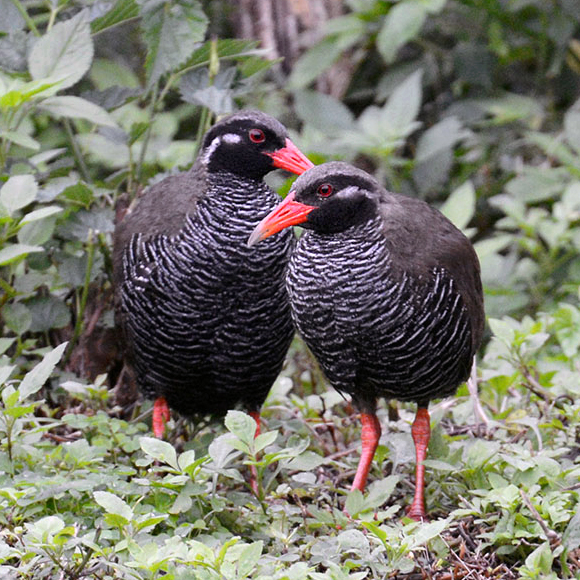
Okinawa Rail |
Lecture 2: Towards the Conservation of the Malayan Colugin in Indonesia Lecturer: Yamato Tsuji (Assistant Professor, Primate Research Institute, Kyoto University)
The Malayan colugo is endemic to Southeast Asia. Although its name includes "monkey," it is not a primate but a dermatomorpha (dermoptera). It has the unusual characteristic of gliding through trees by spreading its gliding membrane. The forests where colugos live are continuously decreasing, but there is not much basic information about their ecology. This time, I will talk about the ongoing research in Indonesia, in particular the ecology related to their movement using radio transmitters, and the "mass die-off" that occurred during the research.
◎Lecturer Profile:
Currently an Assistant Professor in the Social Ecology Division of the Primate Research Institute, Kyoto University. His main research theme is the impact of seasonal and annual changes in habitat on primate ecology. He has conducted research on foraging ecology and interspecies relationships in primates such as Japanese Macaque and leaf monkeys, medium-sized carnivorous animals in the suburbs of Tokyo, and wild animals in Indonesia.
| 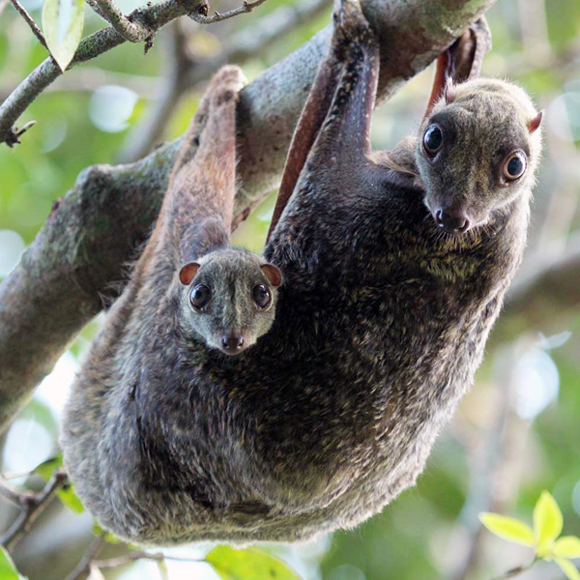
Photographed by Yamato Tsuji |
Lecture 3: Visiting the Prosimians of Madagascar—Focusing on Aye-aye Lecturer: Taizo Shima (Representative of Japan Aye-aye Fund)
Madagascar boasts extremely high primate diversity, home to approximately 100 species of prosimians belonging to five families. The northern region, in particular, contains two species of sifaka, three species of mouse lemurs, and four species of weasel lemurs within a relatively small area, and Aye-aye is also widely distributed. However, the true extent of their population remains largely unknown. This presentation will discuss what we have learned about prosimians through field research, as well as the state of Madagascar's natural environment and the efforts we must make for the future.
◎Lecturer Profile: Graduated from the Department of Anthropology, Faculty of Science, University of Tokyo. Doctor of Science. Chevalier, 5th Class, of the Order of Madagascar. Numerous papers and books published. In 1984, participated in the world's first filming Aye-aye. Since then, has been dedicated to the study of Aye-aye. From 1990 to 2001, stayed at the Tsimbazaza Zoological and Botanical Garden in Madagascar for a total of 6 years and 3 months as a specialist dispatched by the Japan International Cooperation Agency. In January 2002, established the Japan Aye-aye-Aye Fund and became its representative. In August 2002, became Honorary Chairperson of the Madagascar Aye-aye-Aye Fund. | 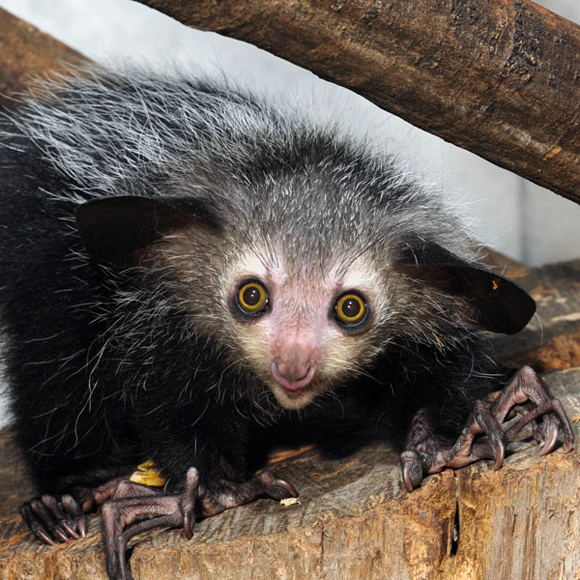
Aye-aye at Ueno Zoo |
How to apply Update: As of 7:45 PM on Monday, March 12, 2018, registration has closed as the maximum number of participants has been reached.Please apply by email to
hozen2018@tokyo-zoo.net. Applications will be accepted on a first-come, first-served basis. The subject line of your email should be "Conservation Fund Lecture 2018," and in the body of the email, please include ① your name (with phonetic spelling), ② your age, ③ your email address, and ④ your phone number ( address is not required). After your application is received, we will send you a participation guide as an email attachment. We kindly ask that you print it out and bring it with you (admission to the zoo will be free).
You can apply for multiple people in one application. In that case, please provide the following information for everyone except the representative: ① Name (with phonetic spelling) and ② Age.
Applications will be accepted on a first-come, first-served basis, and we will announce on this page once the capacity is reached. ⇒Update: March 12, 2018 (Monday) 19:45. Registration is now closed as we have reached full capacity. Thank you for your applications.
We have sent you a PDF of your participation certificate via email. If you have not received the email, or if you do not have access to a printer, please contact us at the phone number or email address listed below.
- Those who have registered will receive a participation certificate via email shortly (please note that these will not be sent out sequentially, so please wait a little while. As mentioned above, registration will continue unless this page displays "Registration Closed").
- Please configure your spam filter settings to allow emails from @tokyo-zoo.net and @tzps.or.jp to be received.
- The personal information you provide when applying will be used solely for contacting you regarding this event. Furthermore, we will strictly manage your personal information, including data storage and deletion.
inquiryTokyo Zoological Park Society Wildlife Conservation Fund Office: 03-3828-8235
(March 2, 2018) (March 12, 2018: Registration closed as the maximum number of participants was reached)
|
|
|
|