At Tama Zoo 's Insectarium Center, we began exhibiting Giant Leaf Insect on the second floor of the main building in August of last year (2016) (
Announcement). As the year changed and the number of adult insects on display decreased due to old age, larvae began hatching one after another from February 2017, as if to replace them.
We continued exhibiting the hatched individuals, but the larvae grew very slowly. Even after the neighboring insect exhibit, the large leaf beetle (Camponotus japonicus), which hatched around the same time, all emerged as adults in the summer, Giant Leaf Insect continued to spend its larval stage at its own pace.
After molting nine times, I was starting to think that none would emerge this year... but on the morning of November 19th, the first adult finally emerged. The earliest hatching was on February 4th, so it seems they were in the larval stage for nearly nine months.
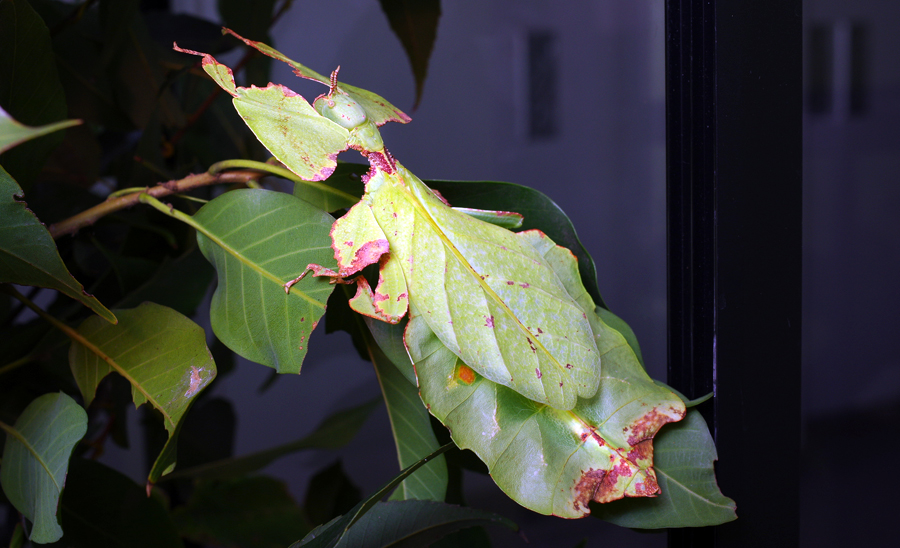
Photo 1: An individual that has emerged from its pupa. The body pattern varies from individual to individual.The fact that they can spend their vulnerable and inherently dangerous larval stage so leisurely may be due to their high camouflage abilities and the stable climate and environment of their habitat in Malaysia (Photo 1).
All Giant Leaf Insect on display are female, and the adults that have emerged are also female. As far as I've been able to confirm, all but two or three of the larvae that have hatched so far have been female, so there seems to be a significant bias in the male-to-female ratio.
 | | 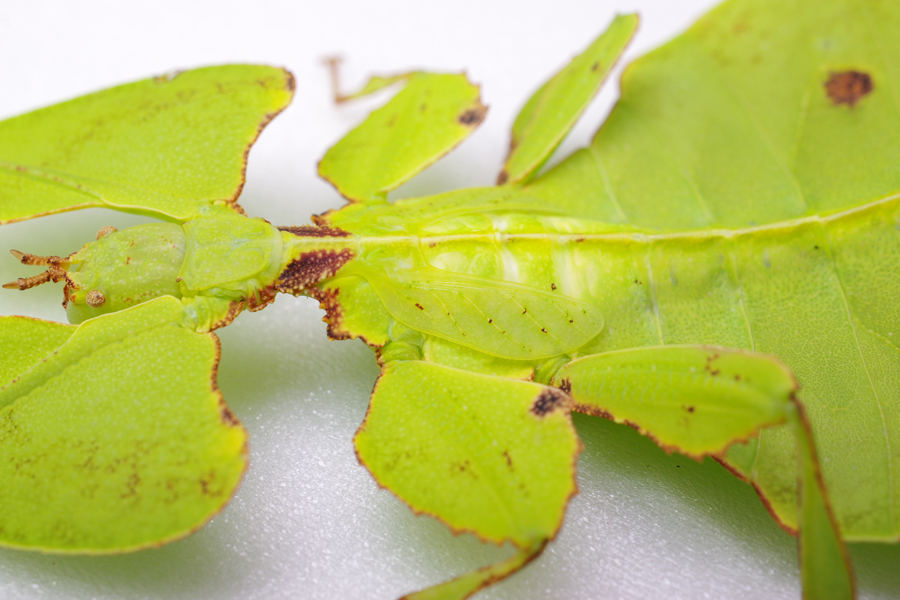 |
Photo 2: A magnificent wing (forewing).
It looks like a single leaf. | Photo 3: "Wing buds" (wings before they develop) of a female final-instar larva.
There is only one pair. |
Adults and larvae look very similar, but upon closer inspection, adults have wings on their backs. However, while insects generally have two pairs of wings, forewings and hindwings, Giant Leaf Insect female leaf beetles only have one pair of forewings. Moreover, these wings only serve to cover their backs and are not used for flight. Instead, the wings are adorned with intricate patterns resembling leaf veins, and when the left and right wings are put together, they form a single leaf (Photos 2 and 3).
Only about 10% of the exhibited insects have emerged so far, so we expect the emergence to continue until around February. These insects are generally nocturnal, so molting and emergence usually occur at night, but occasionally some leisurely individuals will do so during opening hours. You can usually see the emergence at the bottom of the case. If you visit early in the morning, be sure to check it out.
[Ryohei Watanabe, Animal Care and Exhibition Staff, Insectarium Tama Zoo]
(December 15, 2017)