For those of you attending school, do you have subjects you excel at and subjects you struggle with? It's been about two years since we started formal training for the three Asian Elephant at Tama Zoo, and at the beginning, all of them were at roughly the same level, with no difference in their performance on the training menu. However, now each individual has their own strengths and weaknesses.
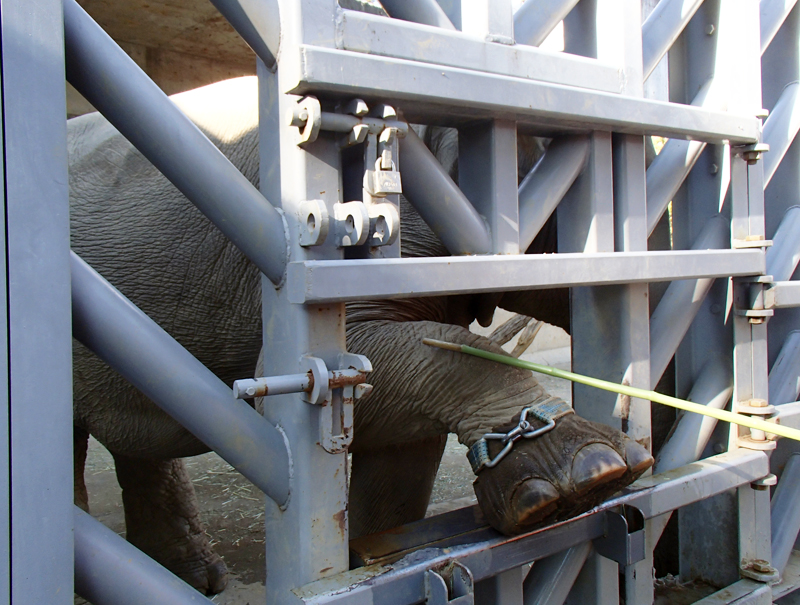
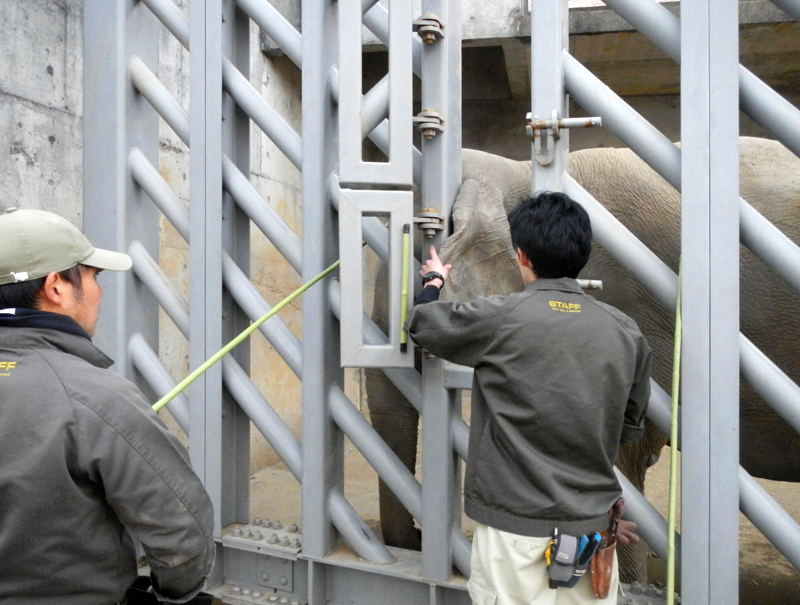
Left: Amara practicing putting an anklet on her front leg. Right: Amara practicing sticking out her ears for blood sampling.The training mainly involves practicing lifting both front and hind legs, practicing wrapping anklets (devices made of thick cloth and metal fasteners) around the front legs for tethering, practicing letting people touch their tails, and practicing moving their ears for blood sampling.
-
An article about anklet wearing training that I previously introduced (December 19, 2014)
For example, the youngest male, Vidura (7 years old), is curious and has a big appetite, so he is the most enthusiastic about training, but he seems to dislike tethering practice. Tethering practice starts with using a thin rope to gradually get the elephants used to having their feet touched, and eventually progresses to being able to put an anklet around their feet. Although Vidura has gotten used to the feel of the rope, he pulls his feet away when someone tries to put the rope around him. Actions that the other two elephants don't mind at all seem to bother Vidura.
Meanwhile, Amara (10 years old), who is like an older sister to Vidura, sometimes loses focus and becomes sluggish, but she is good at tethering practice. She doesn't mind wearing an anklet at all now. However, she is the least comfortable of the three when it comes to blood sampling practice, so we are training her more cautiously than any of the others.
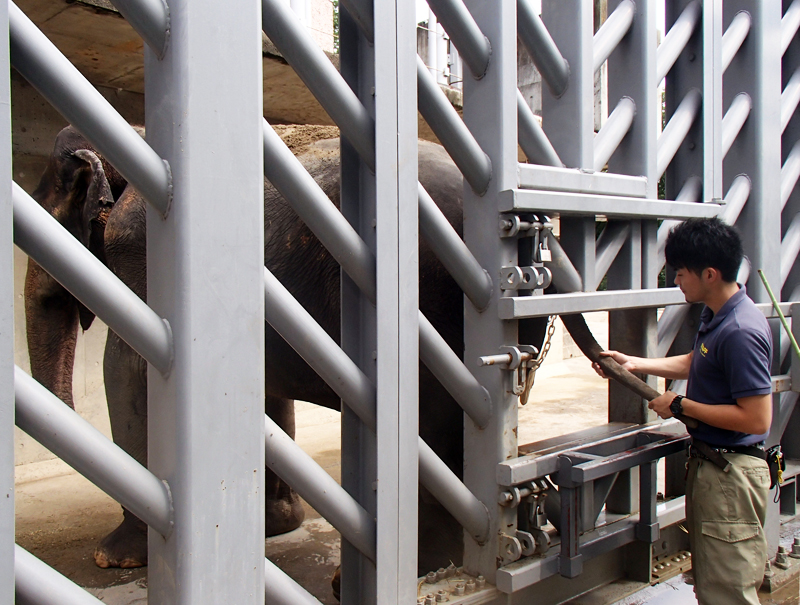
Humans practicing touching the tail (Anura)Anura Grandpa (62 years old), the oldest male in the country, is the most outstanding of the three, and so far there are no exercises he dislikes. If anything, he sometimes refuses training, although it's unclear whether this is due to his age or the environment he grew up in. On warm days like in early spring, he seems to prefer sunbathing to training, and there are times when he won't respond to training no matter how much animal keeper call him. He is the most laid-back of the three and always trains at his own pace, but perhaps it's the wisdom of age that makes him the most stable.
This training program, which we started with the aim of managing the elephants' health, would not be possible without their cooperation. We hope to continue it in a way that is enjoyable for both of us, without discouraging the elephants.
[Tama Zoo Tama Zoological Park]
(May 30, 2015)