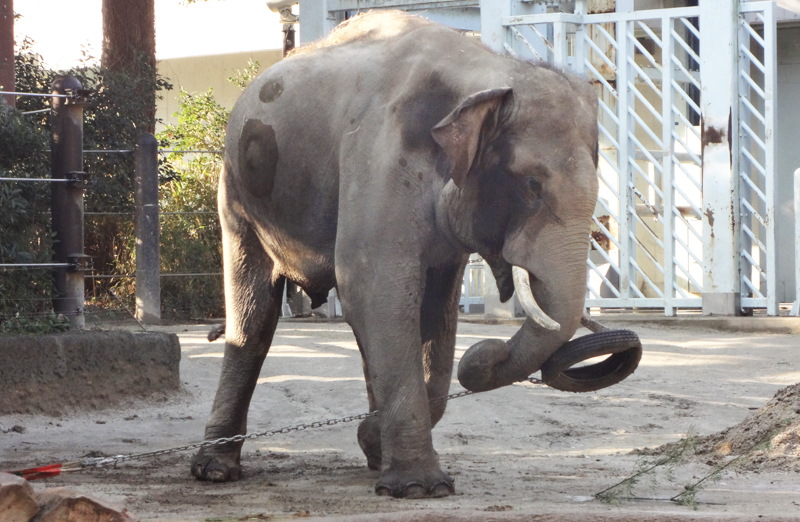
Currently, Ueno Zoo houses four Asian Elephant (one male and three females). In the wild, male calves live in herds, but around the age of 10, they leave the herd and begin to live alone or in groups of only males.
At Ueno Zoo, we keep male and female turtles in separate enclosures, based on their natural habitat. As a result, "Ati," the male turtle, is always alone, which can mean his daily life is somewhat lacking in stimulation. We've long wanted to provide Atti with play equipment to enjoy in his enclosure, and with the help of zoo supporter funds, we've finally been able to make that a reality.
You might think, "Why didn't they prepare playground equipment sooner?" But elephants have tremendous power, so simply placing tires or logs wouldn't work. There was a risk that the elephants would pick them up with their trunks and throw them towards the customers, making installation difficult.
First, we installed hooks in the playground to attach the play equipment. By attaching chains or similar to these hooks and connecting the equipment, it will be impossible for the toys to be thrown too far away.
On New Year's Eve 2014, we decided to try putting tires on her. However, when Atti went out to the playground, she didn't pay any attention to the tires and started eating grass as usual. I was disappointed that she didn't seem very interested, but after a while, she noticed the tires and immediately started playing with them with great excitement.
We have filmed the scene, so please take a look.
Atti playing with the tires while letting out a yell unlike anything we've heard before was a very heartwarming sight (the yell is not included in the video).
However, the next day, perhaps having already lost interest, he showed no signs of the same excitement as the first day, only occasionally touching the toys. I was surprised that he got bored so quickly, but I won't be discouraged. I plan to increase the variety of play equipment and install different toys each day.
Currently, construction is underway to add more fences in front of the male enclosure, so you cannot see the enclosure. However, we are working hard to make it possible for everyone to see Atti playing excitedly, just like in the video, once the construction is finished. Please look forward to that time and wait a little longer.
[Shuhei Mitsuka, Animal Care and Exhibition Staff, Ueno Zoo East Garden]